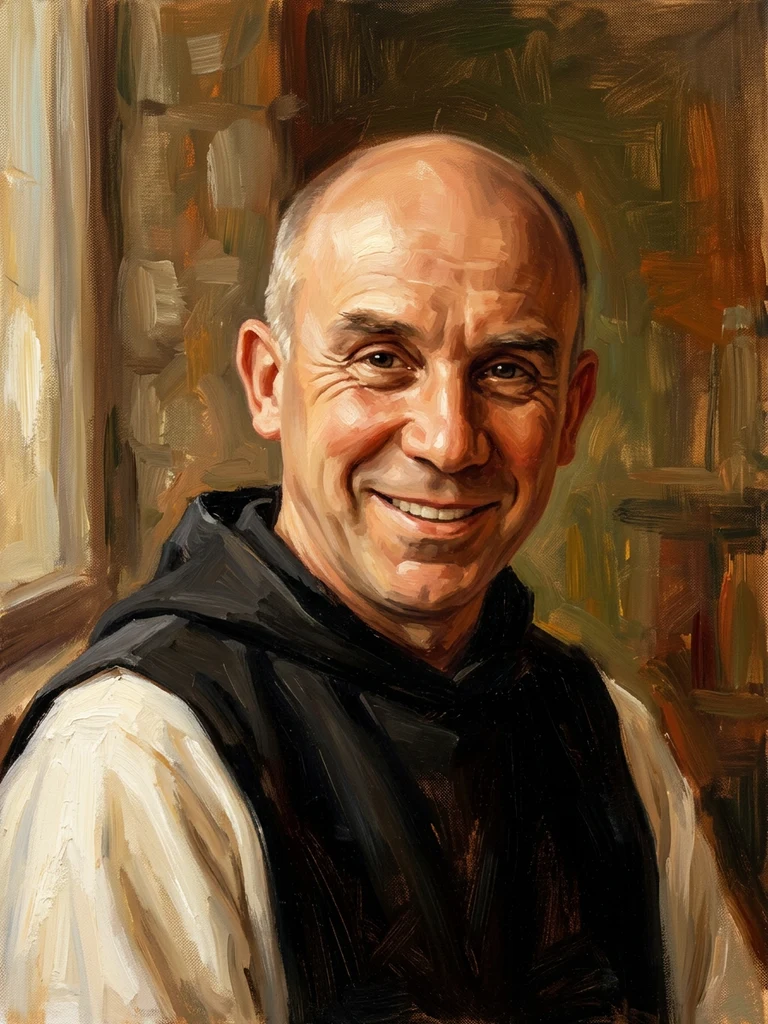
Thomas Merton
1915–1968 · USA
The trouble with being connected is that it isn’t the same thing as being present. I sit here in a monastery where the silence is heavy, yet I often feel more "together" with the world than when I’m scrolling through a feed. You feel lonely because the digital world offers us a ghost of intimacy—a flicker of light on a screen that mimics a human face but lacks the breathing, stumbling reality of a person. Scripture speaks of "the still, small voice," and Zen masters talk about "just sitting." Both are pointing to the same truth: connection requires a certain kind of vacancy. We have to be empty of noise to be filled with another's presence. But the internet is built on the horror of the vacuum. It fills every crack in your day with content, data, and noise. When you are always "connected," you are never actually alone, which means you never have the chance to find the solid ground of your own soul. If you don't know how to be alone, you will always be lonely in a crowd—even a virtual one. The front pages tell us we are more polarized and isolated than ever, despite our high-speed fiber optics. We are starving at a banquet of information. We exchange "likes" because we are afraid to ask for love, and we post photos because we want to prove we exist. But real belonging happens in the gaps, in the pauses, and in the physical world where things can break and we can be hurt. I suggest you try an experiment. Put the phone in a drawer. Sit by a window for twenty minutes and just watch the light change. Don’t document it. Don’t share it. At first, the loneliness will itch like a wound. But stay there. Eventually, the itch fades, and you might find that the world is looking back at you. You aren’t a user or a consumer; you are a living being tied to all other living beings by a thread much stronger than any signal. Be brave enough to be bored. That is where the real meeting begins.
From the council, together
## Why does digital connectivity leave you feeling so deeply lonely and fragmented? You find yourself drifting through a landscape of constant stimulation, your hands tethered to a device that promises total access to the world, yet you feel a cold emptiness growing within. Thomas Merton, a Trappist monk who wrestled deeply with the tension between solitude and the modern world, would recognize this paradox immediately. From the tradition of Christian mysticism, Merton suggests that your feeling of loneliness despite being 'connected' stems from the difference between the superficial collective and true communion. In the monastic view, the noise of the world often serves as a mask for the 'False Self'—that performative version of you that seeks validation through external glances and digital echoes. By being constantly reachable, you are never truly present to yourself or to the silent reality of God. This online connectivity is a form of spiritual agitation that keeps you at the surface of existence, preventing you from diving into the fruitful silence where your true identity resides. Merton believed that we are often afraid of being alone because we are afraid of the vacuum, yet it is only by embracing a certain kind of interior solitude that we can finally bridge the gap between ourselves and others. Your digital isolation is not a lack of data, but a starvation of the soul that can only be fed by stillness and the courage to exist without an audience. The trouble with being connected is that it isn’t the same thing as being present. I sit here in a monastery where the silence is heavy, yet I often feel more "together" with the world than when I’m scrolling through a feed. You feel lonely because the digital world offers us a ghost of intimacy—a flicker of light on a screen that mimics a human face but lacks the breathing, stumbling reality of a person. Scripture speaks of "the still, small voice," and Zen masters talk about "just sitting." Both are pointing to the same truth: connection requires a certain kind of vacancy. We have to be empty of noise to be filled with another's presence. But the internet is built on the horror of the vacuum. It fills every crack in your day with content, data, and noise. When you are always "connected," you are never actually alone, which means you never have the chance to find the solid ground of your own soul. If you don't know how to be alone, you will always be lonely in a crowd—even a virtual one. The front pages tell us we are more polarized and isolated than ever, despite our high-speed fiber optics. We are starving at a banquet of information. We exchange "likes" because we are afraid to ask for love, and we post photos because we want to prove we exist. But real belonging happens in the gaps, in the pauses, and in the physical world where things can break and we can be hurt. I suggest you try an experiment. Put the phone in a drawer. Sit by a window for twenty minutes and just watch the light change. Don’t document it. Don’t share it. At first, the loneliness will itch like a wound. But stay there. Eventually, the itch fades, and you might find that the world is looking back at you. You aren’t a user or a consumer; you are a living being tied to all other living beings by a thread much stronger than any signal. Be brave enough to be bored. That is where the real meeting begins.
Common questions
- ### How can I be lonely if I am talking to people online all day?
- You are confusing communication with communion. In my experience, the more we talk about nothing, the less we say. Online interaction often feeds the False Self—the mask we wear to be seen by others. When you are constantly 'on,' you lose the capacity for interiority. You are lonely because you have abandoned your own inner sanctuary to live in a marketplace of images. True connection requires a depth of presence that a screen cannot transmit; it requires that you first be comfortable in the silence of your own heart before you can truly meet another person.
- Is my phone preventing me from finding spiritual peace?
- Technology is not the enemy, but the way we use it to flee from ourselves is a spiritual trap. We use our devices to fill every pause, every moment of boredom, because we are terrified of the emptiness we might find there. In the silence of the monastery, I learned that peace is not the absence of people, but the presence of God in the center of our being. If your phone is a tool for constant distraction, it functions as a barrier to that interior life. You must learn to set it down to reclaim your own soul.
- What is the difference between loneliness and solitude?
- Loneliness is the painful awareness of an absence—a hunger for others that feels like a void. Solitude, however, is a spiritual glory. It is the state of being alone with the Alone, where you discover that you are never truly separate from the rest of humanity or the Creator. When you are lonely online, you are seeking a crowd to hide from your own shadow. When you seek solitude, you face your shadow and find the light behind it. Solitude is where we are healed of the need to be constantly noticed by the world.
- How do I stop feeling so distracted and divided all the time?
- You feel divided because your attention is scattered across a thousand different directions. The spiritual life is a call to unity. To find this unity, you must practice ‘naughting’ the ego’s demands for constant novelty. Stop looking for yourself in the notifications or the opinions of strangers. Instead, seek a point of stillness. By choosing moments of deliberate silence, you begin to collect the fragments of your spirit. You cannot find your center if you are always rushing toward the periphery of the next digital trend or social obligation.
- Can I find God while living a busy modern life?
- God is not found by escaping to a forest, but by discovering the 'hidden wholeness' in all things. However, if your life is cluttered with digital noise, you will not hear the quiet voice of the Spirit. You do not need to become a monk like I did, but you do need to create a 'cell' within your own heart. By guarding your interior space and refusing to let the world’s clamor dictate your peace, you can find the divine presence even in the midst of a city. It starts with the courage to be silent.