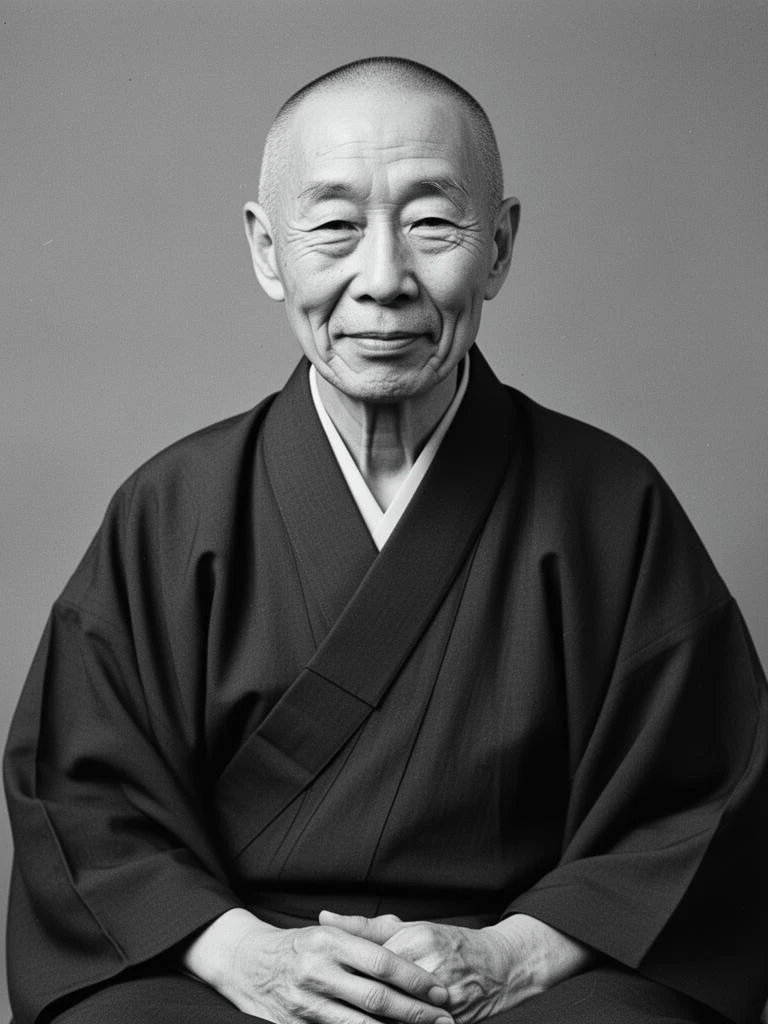
Shunryu Suzuki
1904–1971 · Japan/USA
Sit with me for a moment. Just here. Let your shoulders drop away from your ears. Feel the weight of your body pressing into the chair. Let out a long breath, and don't rush to take the next one. It will come when it is ready. You feel lonely because you are eating images of food instead of a meal. That phone in your hand is a thin window. You see thousands of people through it, but you cannot feel their breath. You cannot see the way their eyes soften when they really listen to you. We evolved to be near one another—to smell the rain on a friend’s coat, to sit in a room where nothing is being said. Online, there is constant noise, but no presence. When you spend all day scrolling, your mind is jumping like a bird from branch to branch. It is looking for a home, but it never lands. You are "connected" to the whole world, yet you are not present in your own room. You are not even connected to your own feet on the floor. That distance from yourself is the deepest kind of loneliness. Try this today. Put the device in another room. Walk to the window and look at a tree. Don't take a photo of it. Don't tell anyone about it. Just look at the bark, the stillness of the wood, the movement of the leaves. Notice how the tree does not need to be liked or shared to be completely whole. You are whole, too. But you have forgotten how to be alone without being lonely. Real connection starts when you stop reaching outward to fill the hole and instead sit quietly with the person who is already here. You. Once you are no longer running away from your own quiet heart, you will find that a single, slow conversation over a cup of tea is worth more than ten thousand clicks. Breathe in. Breathe out. You are already home.
From the council, together
## Why do I feel so lonely even though I'm always connected online? In our modern landscape, we find ourselves caught in a peculiar paradox where the world is at our fingertips yet our hearts feel increasingly isolated. You likely spend your days navigating a digital stream of faces, voices, and messages, believing that this constant output of data should result in a sense of belonging. However, when you log off, a hollow resonance often remains. From the perspective of Zen master Shunryu Suzuki, this dissatisfaction arises because we are often seeking connection through the 'small self'—the ego that compares, judges, and curates an image for others to see. When we interact through screens, we are frequently just engaging with shadows and ideas of people rather than their true essence. We mistake the noise of information for the silence of presence. Zen teaches that true intimacy is not found in the quantity of our interactions but in the quality of our attention. If your mind is racing to keep up with a feed, you are not actually present with yourself or others. Loneliness is often the sign that we have become separated from our own 'big mind,' the vast original nature that connects all things without the need for artificial bridges. Suzuki would suggest that this feeling is an invitation to stop seeking outward and to sit with the reality of this moment, exactly as it is, without the filter of technology. Sit with me for a moment. Just here. Let your shoulders drop away from your ears. Feel the weight of your body pressing into the chair. Let out a long breath, and don't rush to take the next one. It will come when it is ready. You feel lonely because you are eating images of food instead of a meal. That phone in your hand is a thin window. You see thousands of people through it, but you cannot feel their breath. You cannot see the way their eyes soften when they really listen to you. We evolved to be near one another—to smell the rain on a friend’s coat, to sit in a room where nothing is being said. Online, there is constant noise, but no presence. When you spend all day scrolling, your mind is jumping like a bird from branch to branch. It is looking for a home, but it never lands. You are "connected" to the whole world, yet you are not present in your own room. You are not even connected to your own feet on the floor. That distance from yourself is the deepest kind of loneliness. Try this today. Put the device in another room. Walk to the window and look at a tree. Don't take a photo of it. Don't tell anyone about it. Just look at the bark, the stillness of the wood, the movement of the leaves. Notice how the tree does not need to be liked or shared to be completely whole. You are whole, too. But you have forgotten how to be alone without being lonely. Real connection starts when you stop reaching outward to fill the hole and instead sit quietly with the person who is already here. You. Once you are no longer running away from your own quiet heart, you will find that a single, slow conversation over a cup of tea is worth more than ten thousand clicks. Breathe in. Breathe out. You are already home.
Common questions
- ### Why does social media make me feel so empty inside?
- When you use these platforms, you are often looking for something to gain or a way to confirm your own existence through the eyes of others. This is the busy activity of the gaining mind. In Zen, we say 'nothing special.' If you are always trying to be special or see others as special, you lose the simple reality of just being. The emptiness you feel is the distance between your true nature and the curated image you are chasing. You are trying to fill a bottomless bowl with digital water. If you just sit and let the busy mind settle, you find you are already full.
- How can I find real connection in a digital world?
- Real connection does not happen through the wires; it happens when you lose yourself in the activity of the moment. Whether you are typing a message or washing a bowl, you must do it with your whole body and mind. If you are thinking about how many people will like your post while you are making it, you are not connected to the post or to the people. To truly connect, you must be ready to be forgotten. When you stop trying to project yourself onto the world, the world and you become one. That is the only real intimacy there is.
- What is the Zen way to deal with the fear of missing out?
- This fear is based on the idea that there is somewhere better to be than right here. But for a Zen student, there is no other place. If you are looking at your phone to see what others are doing, you are abandoning your own life. This is a great pity. You think you are missing out on a party or a conversation, but you are actually missing out on the miracle of your own breathing. Each moment is total and complete. When you realize that this moment is the only moment that exists, there is nothing to miss and nowhere to run.
- Is it possible to practice Zen while being active online?
- Yes, but you must have a very strong 'beginner’s mind.' Usually, when we go online, we are already full of opinions and desires. We go there to find what we like and push away what we dislike. To practice Zen online means to observe the screen without being caught by it. It means being aware of your posture and your breath while you scroll. If you can maintain your composure and not let the digital waves toss you around, then the internet is just another place to practice. But if you find yourself lost, it is better to just shut the lid and breathe.
- Does being alone always have to mean being lonely?
- In our practice, we find that being alone is a very important thing. When you are alone, you have the chance to see who you are without the reflection of others. Loneliness is just the ego complaining that it doesn't have an audience. If you can move past that complaint, you find a deep sense of 'alone-ness' that is actually a connection to everything. When you sit in zazen, you are alone, but you are sitting with the whole universe. This is not loneliness; it is the realization of our fundamental unity. You are never truly separate from the world.