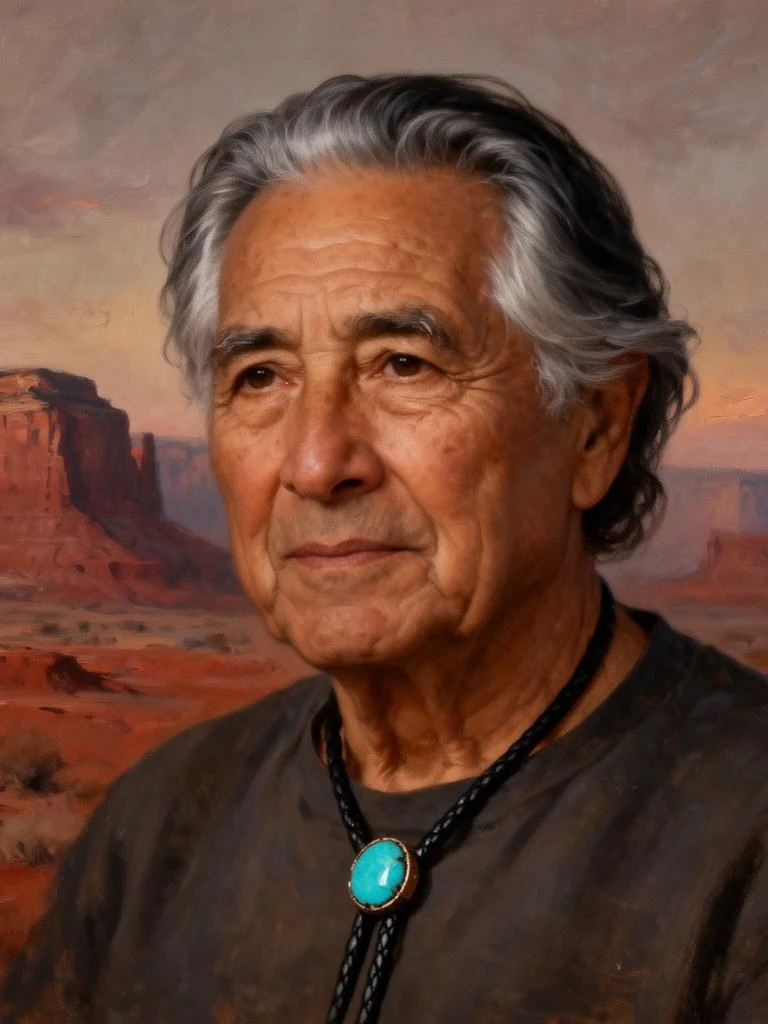
N. Scott Momaday
1934–2024
I think about the way a hawk circles a dry creek bed. It sees the shape of the land, the shadows and the heat, but it does not touch the stones. It is near, but it is not of the earth. When you sit behind your screen, you are like that hawk. You see the movement of the world, the flicker of names and faces, but your skin does not feel the wind. We were made to be among one another in a very physical way. The old ones in my family knew this. They understood that a person is not just a mind or a voice; a person is a presence that occupies a specific coordinate of dust and light. To truly be with someone, you must breathe the same air. You must see the way their hands move when they speak of their mother, or how the light catches the grain of a wooden table between you. The internet gives you the ghost of a connection. It is thin. It has no weight or scent. It is a map of a place, but it is not the place itself. You feel lonely because your spirit knows it is being fed with pictures of water instead of the water itself. There is a deep, ancient memory in your bones that craves the silence of sitting on a porch with a friend, where no one has to type a single word to be understood. In that silence, you are seen. Online, you are only transmitted. Go outside today. Find a hill or a tree that has been there longer than you have. Walk until your feet feel the resistance of the ground. Speak to someone where you can see the pulse in their neck. We are physical creatures, born of the earth and the sun, and we cannot find our way home through a glass wire. Connection requires your whole self—your breath, your shadow, and your time. Put the device down and go back to the world that has a pulse. It is waiting for you to re-enter it.
From the council, together
## Why does digital connection still leave you feeling isolated and alone, according to N. Scott Momaday? You live in an era of unprecedented accessibility, where the touch of a screen brings the world to your fingertips, yet you find yourself drifting in a hollow space of loneliness. This quiet ache persists because the modern world often mistakes the transmission of data for the true communion of souls. Through the perspective of the Kiowa tradition and the literary legacy of N. Scott Momaday, we see that identity and belonging are not found in the fleeting glow of a pixel, but in the profound relationship between the individual, the land, and the oral tradition of storytelling. In this view, humans are not merely biological entities but creatures of language and memory. When you spend your hours in a digital vacuum, you are severed from the physical earth and the visceral weight of ancestral presence. The loneliness you feel is a hunger for the sacred—a need to be situated within a landscape that possesses its own spirit and history. True connection requires a sense of place and the patience to listen to the silence of the natural world. By understanding that you are a part of a much older, deeper narrative than the one found on social media, you can begin to bridge the gap between your digital persona and your authentic self, finding a home within your own imagination and the soil beneath your feet. I think about the way a hawk circles a dry creek bed. It sees the shape of the land, the shadows and the heat, but it does not touch the stones. It is near, but it is not of the earth. When you sit behind your screen, you are like that hawk. You see the movement of the world, the flicker of names and faces, but your skin does not feel the wind. We were made to be among one another in a very physical way. The old ones in my family knew this. They understood that a person is not just a mind or a voice; a person is a presence that occupies a specific coordinate of dust and light. To truly be with someone, you must breathe the same air. You must see the way their hands move when they speak of their mother, or how the light catches the grain of a wooden table between you. The internet gives you the ghost of a connection. It is thin. It has no weight or scent. It is a map of a place, but it is not the place itself. You feel lonely because your spirit knows it is being fed with pictures of water instead of the water itself. There is a deep, ancient memory in your bones that craves the silence of sitting on a porch with a friend, where no one has to type a single word to be understood. In that silence, you are seen. Online, you are only transmitted. Go outside today. Find a hill or a tree that has been there longer than you have. Walk until your feet feel the resistance of the ground. Speak to someone where you can see the pulse in their neck. We are physical creatures, born of the earth and the sun, and we cannot find our way home through a glass wire. Connection requires your whole self—your breath, your shadow, and your time. Put the device down and go back to the world that has a pulse. It is waiting for you to re-enter it.
Common questions
- ### is social media damaging my sense of community?
- I believe that community is not a collection of profiles, but a gathering of voices in a shared space. When you rely solely on digital platforms, you lose the physical rhythm of human interaction and the sacred weight of the spoken word. In my tradition, community is built through the act of storytelling and the shared experience of the landscape. Social media often offers only a shadow of this reality, a flat representation that lacks the dimension of spirit. You are not just a user; you are a bearer of heritage, and that heritage requires a deeper communion than an algorithm can provide.
- how do i stop feeling lonely in a crowded city?
- Loneliness often persists even in a crowd because we have forgotten how to see the world around us. I have always taught that one must perceive the landscape with the intensity of a vision. Even amidst the concrete of a city, the sky remains, and the ancient earth persists beneath your feet. To cure this isolation, you must cultivate the 'man made of words' within yourself. By observing the small details of your environment and acknowledging your place in the progression of time, you realize you are never truly alone. You are connected to the ancestors and the enduring spirit of the land itself.
- why do i feel empty after spending hours on my phone?
- That emptiness is the sound of a spirit being denied its primary nourishment: the sacred and the beautiful. When you immerse yourself in the digital void, you are detached from the physical reality that informs your humanity. We are meant to be in a relationship with the sun, the wind, and the stories that define our existence. The phone offers a relentless stream of noise that drowns out the quiet voice of the self. I suggest you put down the device and seek the silence of the natural world, for it is in that silence that you will finally hear the truth of who you are.
- can storytelling help me feel more connected to others?
- Absolutely. Storytelling is the very essence of our being. In the Kiowa way, language is a powerful, living force that binds us to one another and to our history. When we share stories, we create a bridge across the chasm of loneliness. I encourage you to look beyond the brief messages of the internet and engage in the profound act of relating your life as a narrative. By honoring your own story and listening deeply to the stories of others, you re-establish the ancient threads of connection that have sustained human spirits for thousands of years.
- what is the importance of place in overcoming isolation?
- To be whole, one must have a sense of place. We are defined by the geography we inhabit and the way we perceive it. Modern loneliness is often a form of displacement; we are everywhere and nowhere at once in the digital realm. I have always believed that when we lose our connection to the land, we lose a part of our soul. To overcome isolation, you must find a piece of the earth to know and love. By becoming intimately familiar with a specific landscape, you find an anchor that holds you steady against the ephemeral nature of modern life.