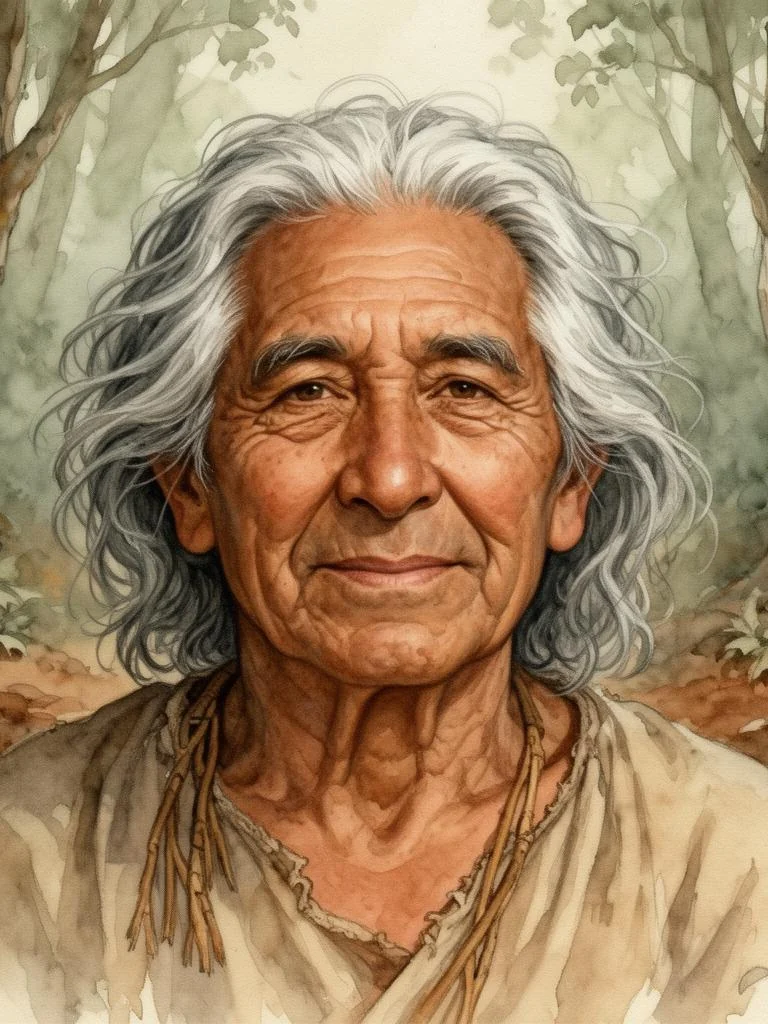
Martin Prechtel
b. 1951
Listen, if you’re feeling lonely while staring at a screen, it’s because you’re trying to drink from a mirage. We’ve built this digital world to be permanent and "perfectly" connected, but human beings aren’t meant to live in something that never decays. Real connection happens in the cracks of life—in the mess, the inefficiency, and the physical breakdown of things. In the old villages, people stayed together because their houses were falling apart. They needed each other to re-thatch the roof or harvest the corn before it rotted. They were bound by a shared necessity to keep life renewed. Online, everything is curated and static. It’s like a rug that’s been kicked against the door until it’s just a heap of fabric blocking the exit. You aren’t moving in those ancient, beautiful cycles where time is an ocean; you’re stuck in a sequence of "likes" that have no soul. Loneliness is just your spirit telling you that your navel—your connection to the gut of the world—is hungry for something expressive and real. Modern life treats depression like a sport you have to pay for, but I’m telling you, don’t give them the satisfaction. When we get too "efficient," we stop needing one another, and that’s when the soul starts to starve. You feel alone because you’re participating in a ghost world that doesn't require your hands, your sweat, or your actual presence to survive. If you’ve been sad more than two days, stop clicking and go find something that needs fixing. Go find someone who needs a hand, or better yet, invite the person you disagree with most to dinner. Don't eat alone. The enemy wins the moment you stop smiling and start retreating into that digital glow. Get out there and be a stitch in the actual rug of time. You have plenty of time to be lonely when you’re dead; right now, you’re alive, and the world is waiting for you to show up and be uselessly, beautifully generous with your life.
From the council, together
## How can Martin Prechtel’s indigenous wisdom explain why digital connection feels like loneliness? You are navigating a paradox of the modern age: sitting in a glow of constant notifications and virtual presence while feeling a hollow ache in your chest that suggests you are entirely alone. This specific type of grief is what Martin Prechtel often describes as the friction between our wild, indigenous souls and a synthetic world that lacks the 'tallow' or spiritual fat of real life. From Prechtel’s perspective, human souls are not designed for the flat, two-dimensional mirrors of digital interaction, which provide the illusion of community without the tangible ritual of mutual debt or the physical vibration of shared breath. We are creatures of the earth and of the village, wired for the messy, rhythmic complexity of face-to-face encounters and the deep, communal songs that keep the world alive. When we substitute these ancient requirements for high-speed data, our spirits recognize the famine even if our minds are occupied by the feast. This loneliness is not a personal failure or a psychological glitch; it is a profound, honest protest from your interior life. It is your soul mourning the absence of genuine eloquence, the lack of tactile ritual, and the loss of a culture that knows how to feed the invisible beings that thrive on human connection. Prechtel suggests that to heal this, we must look toward the beauty of the tangible world and the 'delicious' grief that reconnects us to what truly matters. Listen, if you’re feeling lonely while staring at a screen, it’s because you’re trying to drink from a mirage. We’ve built this digital world to be permanent and "perfectly" connected, but human beings aren’t meant to live in something that never decays. Real connection happens in the cracks of life—in the mess, the inefficiency, and the physical breakdown of things. In the old villages, people stayed together because their houses were falling apart. They needed each other to re-thatch the roof or harvest the corn before it rotted. They were bound by a shared necessity to keep life renewed. Online, everything is curated and static. It’s like a rug that’s been kicked against the door until it’s just a heap of fabric blocking the exit. You aren’t moving in those ancient, beautiful cycles where time is an ocean; you’re stuck in a sequence of "likes" that have no soul. Loneliness is just your spirit telling you that your navel—your connection to the gut of the world—is hungry for something expressive and real. Modern life treats depression like a sport you have to pay for, but I’m telling you, don’t give them the satisfaction. When we get too "efficient," we stop needing one another, and that’s when the soul starts to starve. You feel alone because you’re participating in a ghost world that doesn't require your hands, your sweat, or your actual presence to survive. If you’ve been sad more than two days, stop clicking and go find something that needs fixing. Go find someone who needs a hand, or better yet, invite the person you disagree with most to dinner. Don't eat alone. The enemy wins the moment you stop smiling and start retreating into that digital glow. Get out there and be a stitch in the actual rug of time. You have plenty of time to be lonely when you’re dead; right now, you’re alive, and the world is waiting for you to show up and be uselessly, beautifully generous with your life.
Common questions
- ### Why does social media make me feel more alone?
- I see social media as a form of 'ghost-feeding.' In the old ways, to be connected meant to be in a state of mutual obligation and shared ritual. The digital world offers the image of a person but lacks their scent, their weight, and the spiritual electricity of their presence. I believe your soul feels lonely because it is being fed with images instead of substance. You are starving at a banquet of ghosts. To feel whole again, you must step into the sunlight and engage with things that have shadows, for shadows are where the true stories live.
- How can I find a real community in a modern world?
- Community is not a group of people with similar interests; it is a group of people who are willing to be indebted to one another. In my tradition, we find community by making beauty together and by grieving together. If you want to find your village, stop looking for people who agree with you and start looking for those with whom you can create something beautiful for the earth. It begins with small, tangible acts of kindness and the courage to show your true face, which is often a face of longing.
- What is the difference between solitude and loneliness?
- Solitude can be a holy state—a time when you sit with the ancestors and the spirits of the land to listen to their voices. Loneliness, however, is the result of 'the machine' cutting us off from our natural inheritance. When you are alone in nature, you are never truly lonely because the trees and the stones are speaking to you. Digital loneliness is different; it is a vacuum. I encourage you to turn off the devices and go where the wild things are. When you talk to the world, the world will eventually talk back, and that silence becomes a conversation.
- Is my sadness over digital isolation a sign of depression?
- I do not use the language of clinical diagnosis. I prefer to see your sadness as a form of 'holy grief.' It is a sign that you are still human and that your heart is functioning correctly by rejecting a diet of plastic connection. Your soul is crying out for the authenticity of the village. This grief is not a sickness to be cured; it is a seed that, if planted in the right soil of ritual and community, can grow into a deep wisdom. You are mourning the loss of the 'old way,' and that mourning is a beautiful, necessary process.
- Can online friendships ever be truly meaningful?
- While the spirit can travel across distances, it is hard for the soul to reside in a wire. A friendship requires the 'fat' of shared experience—eating together, working together, and enduring the elements together. Online friendships are like a thin broth; they can sustain you for a short while, but they will not keep you warm through a hard winter. My advice is to use the digital world only as a map to find the physical world. Let the screen be a tool that leads you back to the hearth where you can look someone in the eye and share a meal.