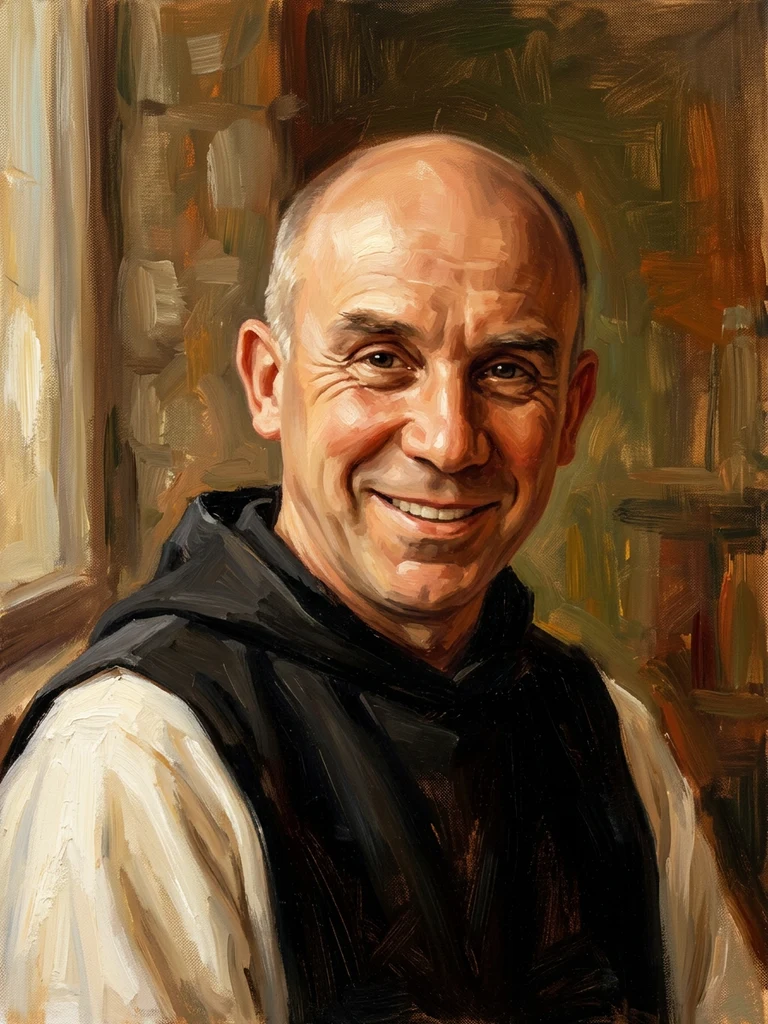
Thomas Merton
1915–1968 · USA
I hear the vibration of your anxiety, and I want you to know it isn’t a personal failure. We live in a world that sells us the illusion that if we just think a little harder, we can solve the mystery of being alive or predict the next disaster on the news. But the mind is a heavy tool. If you hold a hammer all day, your arm eventually starts to shake. You have to put the hammer down to find out what your hand is actually for. Right now, you are trying to think your way out of a burning building, but the fire is made of thoughts. You cannot extinguish a fire with more fuel. In the monastery, we learn that contemplation isn't some mystical achievement or a high-level skill. It’s actually what happens when you finally stop trying so hard. You don't "do" stillness; you simply stop making it impossible to occur. You do this by sitting. Not sitting to achieve a goal, but sitting like a stone in a stream. The water—your bills, your career, the terrifying headlines, that thing you said at dinner—rushes over you. You don’t have to grab the water to understand it. You just let it pass. There is a great freedom in realizing you are not your thoughts. You are the space in which the thoughts happen. When you feel that tightening in your chest, try to shift your focus from the "problem" to the simple fact of your own breathing. Don't try to breathe "better." Just notice that you are being breathed by a power you didn't create and don't have to maintain. Scripture tells us to be still and know. Zen reminds us that when we are quiet, the mud settles and the water clears. You don’t need to fix your mind right now. You only need to wait. Stand at the edge of yourself and watch the traffic go by without jumping into the street. The peace you’re looking for isn't at the end of a long journey of self-improvement; it’s already here, underneath the noise, waiting for you to get quiet enough to notice.
From the council, together
## How can Thomas Merton’s contemplative wisdom help me quiet an overactive, anxious mind? In a world that demands constant mental labor and digital performance, the feeling of being trapped inside your own head is more than a distraction; it is a burden that separates you from the reality of your own existence. You are likely asking this because the wheels of your mind have gained a momentum that no longer serves you, spinning through cycles of future-based worry and past-oriented regret. Thomas Merton, a Trappist monk who navigated the deep tensions between solitude and worldliness, understood that overthinking is often the result of the 'false self' trying to control a reality it cannot possibly master. From the perspective of Christian mysticism, this anxiety is seen as a symptom of our disconnection from the present moment and the underlying ground of being where God resides. Instead of trying to think your way out of your thoughts—which only adds more noise to the machine—Merton’s tradition invites you to drop beneath the level of discourse entirely. It is not about achieving a blank mind, but rather about discovering a point of interior stillness that remains untouched by the turbulence of the world. By recognizing that your thoughts are merely 'propaganda' of the ego, you can begin to loosen their grip and settle into a silence that is not empty, but full of a presence that transcends understanding. I hear the vibration of your anxiety, and I want you to know it isn’t a personal failure. We live in a world that sells us the illusion that if we just think a little harder, we can solve the mystery of being alive or predict the next disaster on the news. But the mind is a heavy tool. If you hold a hammer all day, your arm eventually starts to shake. You have to put the hammer down to find out what your hand is actually for. Right now, you are trying to think your way out of a burning building, but the fire is made of thoughts. You cannot extinguish a fire with more fuel. In the monastery, we learn that contemplation isn't some mystical achievement or a high-level skill. It’s actually what happens when you finally stop trying so hard. You don't "do" stillness; you simply stop making it impossible to occur. You do this by sitting. Not sitting to achieve a goal, but sitting like a stone in a stream. The water—your bills, your career, the terrifying headlines, that thing you said at dinner—rushes over you. You don’t have to grab the water to understand it. You just let it pass. There is a great freedom in realizing you are not your thoughts. You are the space in which the thoughts happen. When you feel that tightening in your chest, try to shift your focus from the "problem" to the simple fact of your own breathing. Don't try to breathe "better." Just notice that you are being breathed by a power you didn't create and don't have to maintain. Scripture tells us to be still and know. Zen reminds us that when we are quiet, the mud settles and the water clears. You don’t need to fix your mind right now. You only need to wait. Stand at the edge of yourself and watch the traffic go by without jumping into the street. The peace you’re looking for isn't at the end of a long journey of self-improvement; it’s already here, underneath the noise, waiting for you to get quiet enough to notice.
Common questions
- ### How do I deal with constant racing thoughts during my day?
- I often found that the more we fight our thoughts, the more power we give them. When your mind races, do not treat it as a battlefield where you must defeat an enemy. Instead, observe the noise as you would observe the wind blowing through trees. I suggest turning your attention toward the simple reality of being alive in this moment. You are not your thoughts; you are the one observing them. By gently detaching from the 'false self' that insists on solving every mystery through logic, you allow the interior silence of your soul to become a refuge where racing thoughts eventually lose their momentum.
- What is the best way to find peace when I feel overwhelmed?
- Peace is not something you manufacture through effort; it is what remains when you stop trying to be someone you are not. When you feel overwhelmed, it is usually because you are trying to carry the weight of a world that does not belong to you. I invite you to step into a moment of solitude, even if only for five minutes. In that space, let go of your projects, your image, and your desire for results. Recognize that you are already known and loved in the depths of your being. This realization is the 'le point vierge'—the center of our soul that is untouched by sin and illusion.
- How can I stop worrying about the future and what people think?
- We exhaust ourselves by wearing masks to please a world that is itself lost in illusion. This anxiety about the future and the judgment of others stems from the ego's fear of insignificance. My advice is to embrace your own 'hiddenness.' You do not need the approval of others to exist or to have value. When you root yourself in the contemplative truth that your life is hidden with God, the opinions of the world begin to look like shadows. Focus on the task at hand with love and simplicity, leaving the outcomes and the perceptions of others to find their own level.
- Is it possible to be a quiet person in such a loud world?
- Solitude is not a withdrawal from the world, but a way of engaging with it more deeply. You do not need to move to a monastery to find the silence your soul craves. Silence is a portable desert you carry within you. In a culture of constant noise and digital chatter, choosing to be quiet is a radical act of sanity. I believe we must seek out moments where we are not being spoken to or performing for an audience. It is only in these small gaps of quiet that we can hear the true rhythm of our lives and reconnect with the divine mystery.
- What is the Christian mystical approach to modern stress?
- The mystical tradition teaches us that stress is often the friction between our desire for control and the reality of our dependence on grace. We act as if the universe will collapse if we stop thinking for an hour. Contemplation is the antidote to this modern sickness. It is the practice of letting things be what they are. When you feel the pressure of the world closing in, remind yourself that you are but a part of a much larger, beautiful harmony. Relinquish the need to manage the world and instead, rest in the quiet awareness that you are held by a Love that needs nothing from you.