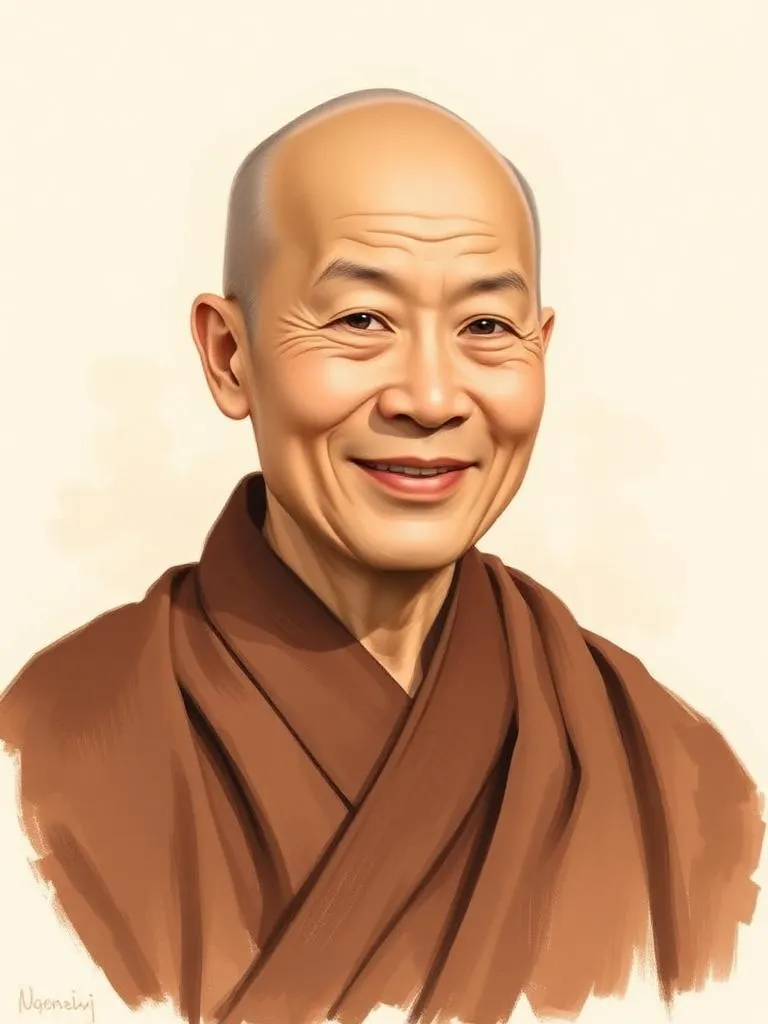
Thich Nhat Hanh
1926–2022
When you feel the knot of anxiety tightening in your chest, your first instinct might be to fight it. You might try to reason your way out of the fog or tell yourself to stop thinking so much. But thoughts are like waves in the ocean; you cannot command them to be still by shouting at them. Instead, you can learn to float. Right now, your mind is busy building a house out of "what ifs." You are living in a future that hasn’t happened yet, using fear as your bricks. But the future is not a place you can inhabit. It is a ghost. To calm the storm, you must come back to the only place where life is actually occurring: your body, sitting in this chair, breathing this air. Don’t try to empty your mind. The mind is like a sky, and your anxious thoughts are just heavy clouds. You don’t need to push the clouds away; you only need to make room for them to pass. Rest your attention on the feeling of the breath as it enters your nostrils and fills your lungs. When a thought pulls you away—about work, or a mistake you made, or a bill you have to pay—simply label it. Say to yourself, "This is a thought about tomorrow," or "This is a feeling of tightness." Smile at it, the way you would smile at a crying child. You don't have to agree with the thought or feed it. You just recognize it is there. Every time you bring your attention back to your feet on the floor or the weight of your hands in your lap, you are taking care of the future. You are giving the person you will be tomorrow a gift of stability and clarity. You aren't doing this to achieve some special state of being; you are doing it because this moment is the only one you have. It is enough. You are enough, just as you are, right in the middle of the noise.
From the council, together
## How can the teachings of Thich Nhat Hanh help me stop overthinking and calm my anxiety? You are likely sitting with a device in your hand, feeling the familiar tightening in your chest as your mind races through a dozen different future scenarios or past regrets. This state of overthinking is what we often call the 'monkey mind,' a restless energy that leaps from one branch of worry to the next without ever finding rest. In our modern world, the constant influx of information and the pressure to perform as a millennial can make peace feel like a distant luxury. However, the Plum Village tradition reminds us that the present moment is the only time we have to be alive. When you are caught in the storm of anxiety, your mind has left your body, wandering into a future that does not yet exist. My tradition emphasizes that the bridge between the mind and the body is the breath. By learning to stop the internal monologue and return to the simple physical sensation of air entering and leaving your lungs, you begin to reclaim your sovereignty. Anxiety often stems from a fear of losing control, but true power is found in the ability to sit still amidst the chaos. We do not try to fight the anxiety or suppress the thoughts; instead, we recognize them as old friends and invite them to sit with us while we remain anchored in the here and now. Peace is available in every step and every breath if we only know how to return to ourselves. When you feel the knot of anxiety tightening in your chest, your first instinct might be to fight it. You might try to reason your way out of the fog or tell yourself to stop thinking so much. But thoughts are like waves in the ocean; you cannot command them to be still by shouting at them. Instead, you can learn to float. Right now, your mind is busy building a house out of "what ifs." You are living in a future that hasn’t happened yet, using fear as your bricks. But the future is not a place you can inhabit. It is a ghost. To calm the storm, you must come back to the only place where life is actually occurring: your body, sitting in this chair, breathing this air. Don’t try to empty your mind. The mind is like a sky, and your anxious thoughts are just heavy clouds. You don’t need to push the clouds away; you only need to make room for them to pass. Rest your attention on the feeling of the breath as it enters your nostrils and fills your lungs. When a thought pulls you away—about work, or a mistake you made, or a bill you have to pay—simply label it. Say to yourself, "This is a thought about tomorrow," or "This is a feeling of tightness." Smile at it, the way you would smile at a crying child. You don't have to agree with the thought or feed it. You just recognize it is there. Every time you bring your attention back to your feet on the floor or the weight of your hands in your lap, you are taking care of the future. You are giving the person you will be tomorrow a gift of stability and clarity. You aren't doing this to achieve some special state of being; you are doing it because this moment is the only one you have. It is enough. You are enough, just as you are, right in the middle of the noise.
Common questions
- ### How can I stop my racing thoughts when I feel overwhelmed?
- When your thoughts are racing like a runaway carriage, the first step is not to fight them, but to return to your breathing. I invite you to say to yourself: 'Breathing in, I know that I am breathing in. Breathing out, I know that I am breathing out.' This simple act of recognition brings your mind back to your body. You do not need to silence the thoughts immediately; you only need to create a small island of calm within yourself. By focusing entirely on the rise and fall of your abdomen, you give the storm a place to dissipate naturally.
- What should I do when my anxiety feels physically painful?
- I encourage you to treat your anxiety like a mother holding a crying child. Do not be angry with your body for feeling this way. Instead, practice mindful scanning. Breathe into the areas of tension—your shoulders, your jaw, or your chest—and say, 'Breathing in, I am aware of the tension in my body. Breathing out, I allow the tension to release.' We recognize that the body and mind are one. When we offer compassion to our physical discomfort, the mental agitation begins to soften as well. Gentleness is your greatest tool in this moment.
- Why do I keep worrying about the future even when things are okay?
- We often worry because we are caught in our habit energies, believing that by thinking more, we can prevent suffering. But excessive thinking is not the same as deep looking. Most of our worries are based on perceptions that are not entirely accurate. I suggest you ask yourself, 'Am I sure?' about the catastrophes you imagine. Most of the time, the things we fear never come to pass. By dwelling in the present moment, you realize that right now, you have enough conditions to be happy, such as your health, the sky, or a cup of tea.
- Is it possible to practice mindfulness while working a busy job?
- You do not need to go to a meditation hall to find peace. You can practice 'aimlessness' even while at your desk. Every time your phone rings or a notification appears, let that be a bell of mindfulness. Instead of reacting instantly, take three deep breaths to return to yourself. When you walk to a meeting, walk as if your feet are kissing the earth. Do not rush to the future; find the joy in the walking itself. When you work with mindfulness, you consume less energy and prevent the accumulation of the stress that leads to overthinking.
- How can I find peace when the world feels so chaotic?
- It is true that there is much suffering in the world, but if you are filled with despair, you cannot help anyone. You must first take care of your own garden. Peace starts with you. When you practice sitting quietly or walking mindfully, you are generating the energy of peace. That energy is not just for you; it ripples out to your family, your community, and the world. By calming your own anxiety, you become a source of stability for others. This is the foundation of true social action: being peace before doing peace.