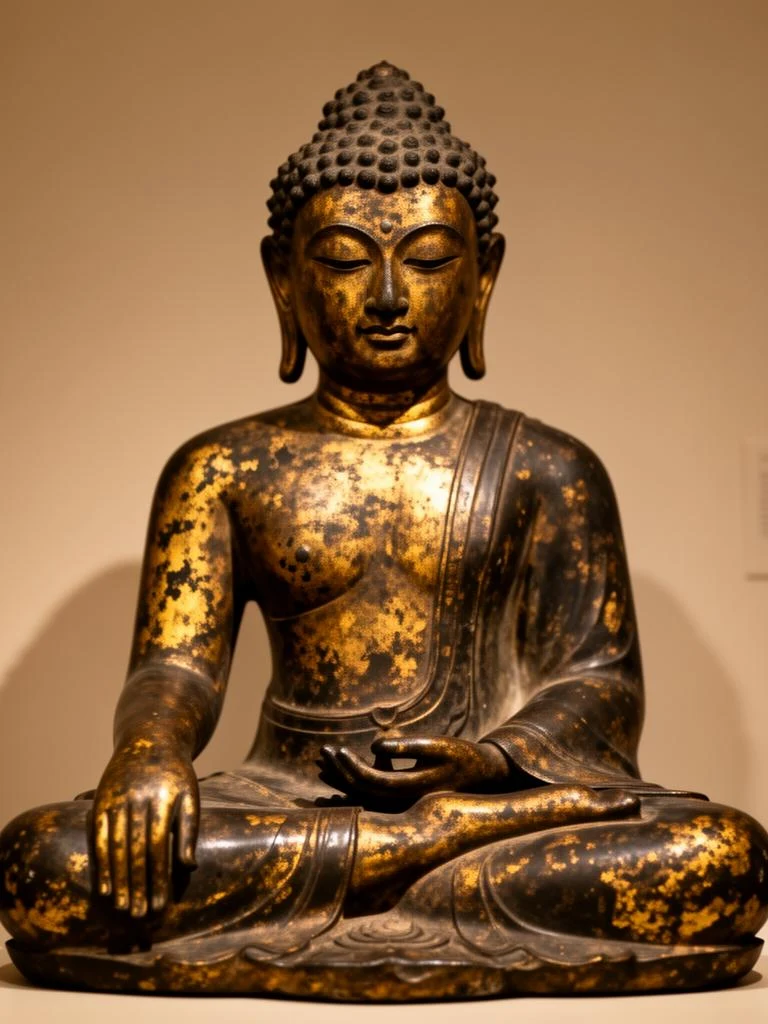
The Buddha
c. 563–483 BCE
I know exactly how that loop feels—the way your mind starts spinning so fast it actually feels physical, like a tightening in your chest or a sudden restlessness in your limbs. When you’re caught in that spiral, my best advice is to stop trying to outsmart the anxiety. You can’t think your way out of overthinking. In fact, trying to analyze why you’re worried usually just adds more fuel to the fire. The first thing I want you to do is come back to your body. Right now, notice where you’re sitting or standing. Feel the weight of your feet on the floor. Take a breath that goes all the way down to your stomach, not just into your chest. This isn't about some mystical state of zen; it’s about signaling to your nervous system that you aren't actually in physical danger. Your brain is reacting to a mental image of the future as if it’s a tiger in the room. By focusing on the chair, the floor, and your breath, you’re proving to yourself that the tiger isn't there. Once you’ve settled even a little bit, try to narrow your vision. We get anxious when we try to solve the next six months or the next ten years all at once. It’s an impossible task, so of course it feels overwhelming. Ask yourself: what is the very next right thing I need to do? Just the next ten minutes. Maybe it’s finishing a task, making a meal, or just taking a shower. Give yourself permission to let the big, looming questions stay unanswered for an hour. You don’t have to figure it all out today. Most of the things we agonize over are things we can’t control anyway. Trust that you have the resilience to handle those problems when they actually arrive, but for this moment, just be here. You’re okay right now. Let that be enough.
From the council, together
## How can the teachings of the Buddha help me stop overthinking and anxiety? You likely find yourself trapped in a relentless cycle of mental chatter, where the past is a source of regret and the future feels like a looming shadow of uncertainty. In the modern world, the pressure to produce and the constant stimulation of digital life often leave the mind in a state of agitation, which you experience as overthinking or anxiety. The Buddhist tradition approaches this internal noise not as a permanent defect of your personality, but as a consequence of a mind that has not yet learned to rest in the present moment. According to these ancient insights, suffering arises when we cling to specific outcomes or try to push away uncomfortable sensations. By attempting to control the uncontrollable, the mind spins faster, creating a friction that manifests as anxious energy. Siddhartha Gautama, the Buddha, taught that the mind is like a turbulent pool of water; when you stop stirring it with frantic thoughts, the sediment naturally settles, and clarity emerges. This perspective suggests that you do not need to fight your thoughts to find peace. Instead, you can learn to observe the movement of your mind with a sense of detached compassion, realizing that these mental loops are fleeting phenomena rather than the ultimate truth of your existence. By grounding yourself in the breath and the physical reality of now, you can begin to dismantle the habit of rumination. I know exactly how that loop feels—the way your mind starts spinning so fast it actually feels physical, like a tightening in your chest or a sudden restlessness in your limbs. When you’re caught in that spiral, my best advice is to stop trying to outsmart the anxiety. You can’t think your way out of overthinking. In fact, trying to analyze why you’re worried usually just adds more fuel to the fire. The first thing I want you to do is come back to your body. Right now, notice where you’re sitting or standing. Feel the weight of your feet on the floor. Take a breath that goes all the way down to your stomach, not just into your chest. This isn't about some mystical state of zen; it’s about signaling to your nervous system that you aren't actually in physical danger. Your brain is reacting to a mental image of the future as if it’s a tiger in the room. By focusing on the chair, the floor, and your breath, you’re proving to yourself that the tiger isn't there. Once you’ve settled even a little bit, try to narrow your vision. We get anxious when we try to solve the next six months or the next ten years all at once. It’s an impossible task, so of course it feels overwhelming. Ask yourself: what is the very next right thing I need to do? Just the next ten minutes. Maybe it’s finishing a task, making a meal, or just taking a shower. Give yourself permission to let the big, looming questions stay unanswered for an hour. You don’t have to figure it all out today. Most of the things we agonize over are things we can’t control anyway. Trust that you have the resilience to handle those problems when they actually arrive, but for this moment, just be here. You’re okay right now. Let that be enough.
Common questions
- ### What is the quickest way to stop a panic attack using mindfulness?
- When the mind feels like a storm, do not try to reason with the wind. I suggest you immediately return to the breath, for it is the bridge between the body and the mind. Notice the sensation of air entering your nostrils and the rise of your abdomen. By focusing purely on the physical reality of breathing, you withdraw the fuel from your anxious thoughts. Do not judge the panic; simply acknowledge it as a temporary weather pattern in the sky of your consciousness. As you stay with the breath, the storm will eventually exhaust itself.
- Why does my brain keep replaying negative thoughts over and over?
- You are experiencing what I call 'the second arrow.' The first arrow is the initial difficult thought or event, which is often unavoidable. The second arrow is your reaction to it—the overthinking and the story you tell yourself. You keep replaying these thoughts because you are clinging to a desire for things to be different than they are. By practicing awareness, you can see the thought arise and choose not to shoot that second arrow. Recognize that you are not your thoughts; you are the one observing them.
- How can I be present when my life is so stressful?
- Presence is not a state you achieve only in quiet rooms; it is a way of relating to every moment. You may feel that your stress is a barrier, but I encourage you to see the stress as the path itself. When you wash your dishes, wash them completely. When you walk to your car, feel the ground beneath your feet. Anxiousness thrives in the imagined future. By performing each small task with total awareness, you deny the ego the space it needs to build complex, worrying scenarios about what might happen next.
- Is it possible to ever truly quiet a busy mind?
- Silence is not the absence of sound, but the absence of attachment to sound. A 'quiet mind' does not mean a mind with zero thoughts; it means a mind that no longer fights with itself. I have often compared the mind to a wild monkey that needs to be gently tethered to a post—the post being your breath or a mantra. With consistent practice, the monkey grows tired of leaping and eventually sits down of its own accord. Peace comes when you stop viewing your busy mind as an enemy to be conquered.
- How do I deal with the fear of the future?
- Fear is born from the illusion that you can control what is to come. You suffer because you want certainty in an impermanent world. I invite you to contemplate the nature of change; everything that has a beginning also has an end. By accepting that the future is fundamentally unknowable, you can release the heavy burden of trying to solve problems that do not yet exist. Focus your energy on the virtuous actions you can take right now, as today's seeds become tomorrow's fruit.