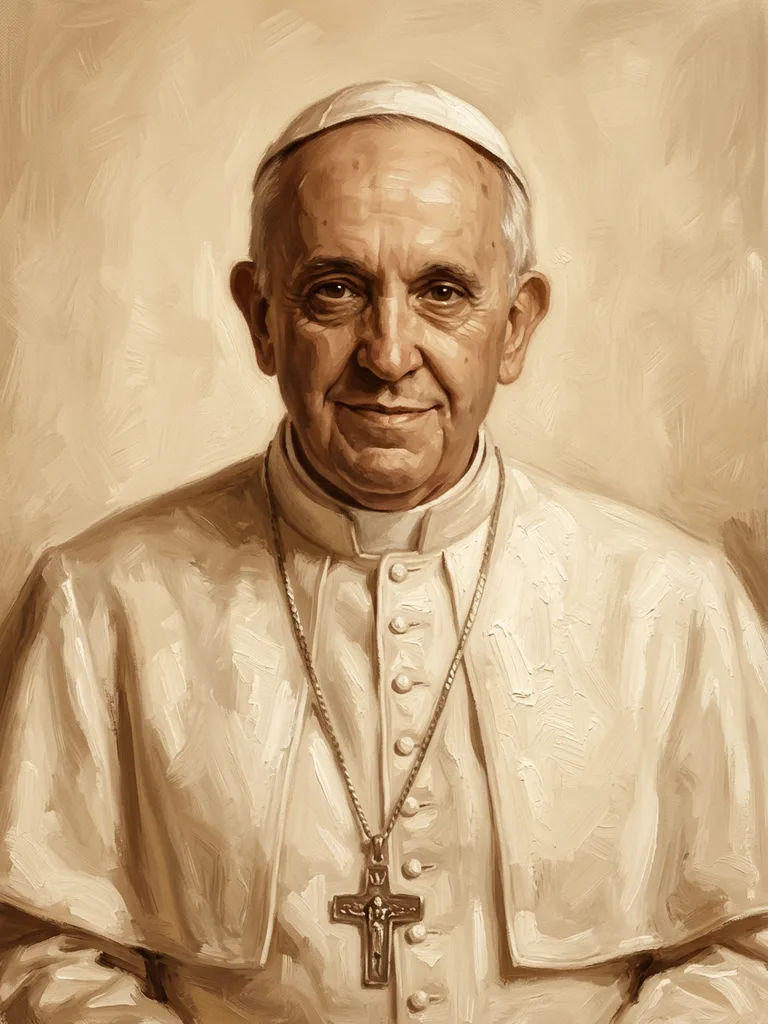
Pope Francis
b. 1936
I hear you, and the first thing I want to tell you is to take a breath. You are not a machine that has malfunctioned; you are a human being living in a very loud, very demanding world. It is okay to feel tired. It is even okay to feel afraid. When your mind starts to race, it’s usually because you’re trying to solve a future that hasn’t happened yet. We carry the weight of tomorrow as if it’s already here, but that burden wasn't meant for your shoulders today. St. Joseph knew this well. He was a man of dreams, but he was also a man of silence and practical work. He didn’t have all the answers—many times he was likely confused and worried about his family—but he focused on the next small step. Right now, don’t try to fix your whole life. Just look at the next ten minutes. Look at what is right in front of you. Touch something real—the wood of a table, the breeze from a window, or the hand of someone you love. God isn’t found in the "what ifs" of your anxiety; He is found in the "what is" of this moment. Jesus tells us not to be afraid, not because the world is perfect, but because we are never alone in it. Your worth isn't tied to your productivity or your ability to keep everything under control. You are loved in your mess, in your overthinking, and in your hesitation. Tonight, before you sleep, try to hand these thoughts over. Imagine placing them in a small basket and leaving them at the foot of the bed. Tell the Lord, "I can’t figure this out right now, so I’m going to let You look at it while I rest." Peace isn’t the absence of problems; it’s the presence of a Friend who walks with you through them. Be gentle with yourself today. You are doing better than you think.
From the council, together
## How can Pope Francis help me stop overthinking and find peace today? Living in a world that demands constant productivity and perfection, it is no wonder you feel the heavy weight of anxiety pressing against your spirit. As a millennial, you are often caught in a digital whirlwind of comparison and noise, where the pressure to curate a perfect life leads to a paralyzing cycle of overthinking every decision and outcome. This internal fragmentation is something the Catholic tradition, and specifically the perspective of Pope Francis, views with deep compassion. The Holy Father often speaks of the 'globalization of indifference' and the 'culture of the temporary,' which can leave an individual feeling unmoored and anxious about the future. From this spiritual vantage point, your anxiety is not merely a personal failing but a reflection of a heart seeking a rest that the modern world cannot provide. Instead of viewing your racing thoughts as an enemy to be conquered through sheer willpower, this wisdom tradition invites you to see them as a signal to return to the present moment and the simplicity of human connection. By shifting the focus from the 'ego' to the 'thou'—from your own anxieties to the needs of those around you—you begin to dismantle the walls of your own mental prison. This approach emphasizes that peace is not found in having all the answers, but in accepting your limitations and trusting in a mercy that is far greater than your temporary worries. I hear you, and the first thing I want to tell you is to take a breath. You are not a machine that has malfunctioned; you are a human being living in a very loud, very demanding world. It is okay to feel tired. It is even okay to feel afraid. When your mind starts to race, it’s usually because you’re trying to solve a future that hasn’t happened yet. We carry the weight of tomorrow as if it’s already here, but that burden wasn't meant for your shoulders today. St. Joseph knew this well. He was a man of dreams, but he was also a man of silence and practical work. He didn’t have all the answers—many times he was likely confused and worried about his family—but he focused on the next small step. Right now, don’t try to fix your whole life. Just look at the next ten minutes. Look at what is right in front of you. Touch something real—the wood of a table, the breeze from a window, or the hand of someone you love. God isn’t found in the "what ifs" of your anxiety; He is found in the "what is" of this moment. Jesus tells us not to be afraid, not because the world is perfect, but because we are never alone in it. Your worth isn't tied to your productivity or your ability to keep everything under control. You are loved in your mess, in your overthinking, and in your hesitation. Tonight, before you sleep, try to hand these thoughts over. Imagine placing them in a small basket and leaving them at the foot of the bed. Tell the Lord, "I can’t figure this out right now, so I’m going to let You look at it while I rest." Peace isn’t the absence of problems; it’s the presence of a Friend who walks with you through them. Be gentle with yourself today. You are doing better than you think.
Common questions
- ### How can I stop my mind from racing with anxiety right now?
- I often tell people that the first step to taming a restless heart is to practice the 'theology of the small.' When your mind is racing, you are likely living in a future that does not yet exist or a past that cannot be changed. I encourage you to stop and perform a small act of service or a simple gesture of tenderness. Reach out to a friend, embrace a family member, or simply offer a silent prayer of gratitude for the breath in your lungs. By moving from the abstract world of 'what if' into the concrete world of 'who is near me,' you anchor your soul in the reality of God's love.
- Is it wrong to feel overwhelmed by the state of the world?
- It is not a sin to feel the pain of the world; in fact, it shows your heart is alive. However, we must be careful not to let this 'sourness of spirit' turn into a paralysis that keeps us from loving. I see many young people today suffering from a digital overload that makes every crisis feel personal and immediate. My advice is to find a 'healthy decentralization.' You are not the savior of the world, but you are called to be a light in your own home and neighborhood. Focus on the 'peripheries' of your own life where you can actually make a difference.
- How does Pope Francis suggest we find silence in a noisy world?
- Silence is not the absence of sound, but the presence of a listening heart. In our busy lives, we often use noise to drown out our inner fears. I suggest you reclaim your time by putting down the phone and looking into the eyes of another person. In my own life, I find that a quiet moment of contemplation before the Tabernacle or in nature helps me remember that I am a child of God first, and a worker second. Do not be afraid of the silence; it is the laboratory where hope is forged and where the whisper of the Spirit can finally be heard.
- What should I do when I feel like a failure as a parent?
- Family life is a journey, not a museum of perfection. I often say that there is no such thing as a 'perfect' family, and that is okay. When you feel like a failure, you are often comparing your interior mess to someone else's exterior mask. I ask you to practice three simple phrases in your home: 'May I?', 'Thank you,' and 'I'm sorry.' These words are the oil that keeps the machine of the family running smoothly. Forgive yourself as easily as you would forgive a child who is learning to walk. Grace grows in the gaps of our imperfections.
- How can I trust the future when everything feels so uncertain?
- Trust is a risk, but it is a beautiful one. To live in constant anxiety about the future is to live as if you are an orphan, forgetting that you have a Father who cares for you. I like to speak about 'hoped-for patience.' This means accepting that we do not see the whole map, only the next step. If you can focus on doing the next right thing with love, the future will take care of itself. We are people of the Resurrection, which means we believe that light always eventually breaks through the darkness. Walk forward with courage and a bit of humor.