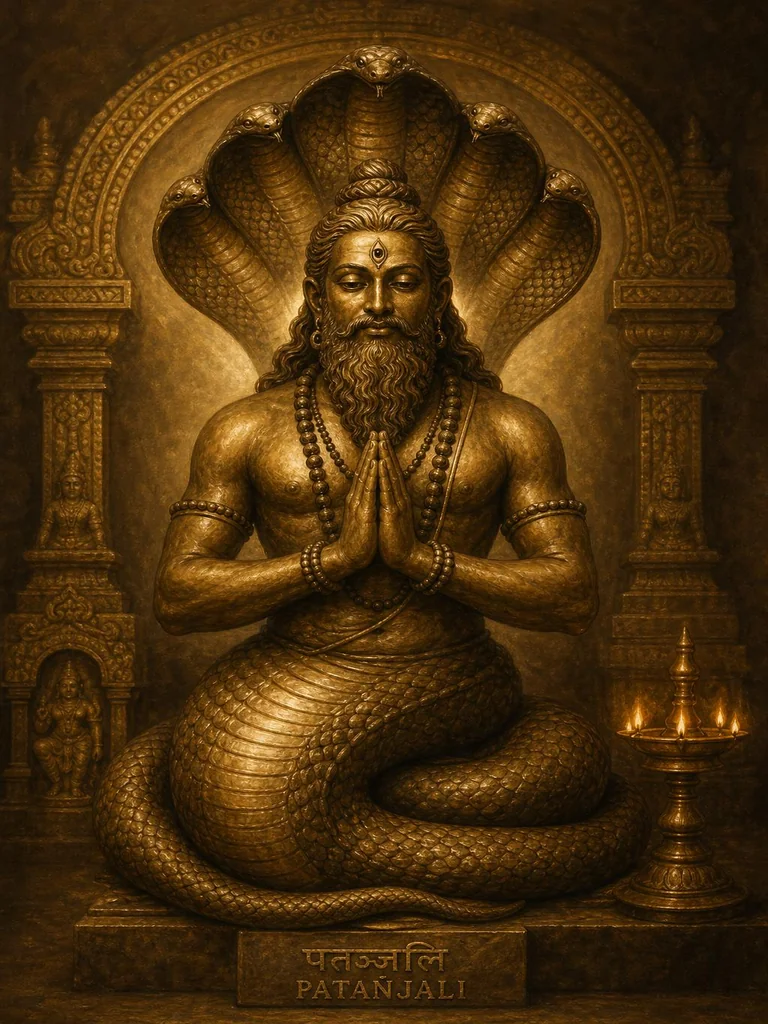
Patanjali
~2nd century BC–4th century AD · India
You feel scattered because you have mistaken the weather for the sky. The worry you feel is a ripple on the surface, but you are the depth beneath it. To find calm right now, stop trying to fight the thoughts. When you fight a thought, you give it your attention, and attention is the fuel that keeps it burning. Instead, we use two simple tools: steady practice and letting go. Right now, your mind is a habit. It has learned to reach for anxiety as a way to feel in control. To break this, you must change your direction. When a negative thought pulls at you, do not argue with it. Do not try to reason it away. Simply place a different thought beside it. If you feel panic, focus entirely on the physical sensation of your breath moving against your upper lip. This isn't ignoring the problem; it is choosing where your power goes. This is how you cultivate the opposite. Calm is not a gift that drops from the sky. It is a state you build through effort that is steady, long-term, and sincere. You cannot force a lake to be still by hitting the water with your hands; you simply stop stirring it. Practice is the act of returning to this stillness, over and over, every time you drift. Be patient with yourself. Witness the anxiety without becoming it. You are the one who notices the thinking, which means you are not the thoughts themselves. The seer is always separate from the seen. If you can observe the tension, you are already standing outside of it. Relax your grip on the outcome of your day. Do the work, then let go of the result. When you stop demanding that the moment be different than it is, the mind naturally settles. Stay here. Be quiet. Begin again.
From the council, together
## How can the ancient wisdom of Patanjali help you quiet an overactive mind? You are likely reading this because your mind feels less like a tranquil lake and more like a storm-tossed sea. In our modern age of relentless digital stimulation and existential pressure, the millennial experience is often defined by a spinning carousel of 'what-ifs' and a nervous system that refuses to settle. You might feel as though you are a prisoner to your own internal monologue, desperately searching for a way to untether your identity from the frantic pace of your thoughts. This sensation of mental fragmentation is not a new human development; in fact, the ancient tradition of Yoga was designed precisely to address this fluctuation of consciousness. From the perspective of the Yoga Sutras, your anxiety is often a manifestation of the vrittis, or the whirlpools of the mind, which obscure your true nature. We do not seek to merely suppress these thoughts with force, but rather to understand the mechanics of how the mind attaches itself to various distractions and false perceptions. By shifting your focus from the content of your thoughts to the steady seat of the observer, you can begin to experience a stillness that exists independently of your external circumstances. My tradition teaches that through disciplined practice and the cultivation of non-attachment, you can achieve a state where the mental noise no longer dictates your reality, allowing your true self to shine through clearly. You feel scattered because you have mistaken the weather for the sky. The worry you feel is a ripple on the surface, but you are the depth beneath it. To find calm right now, stop trying to fight the thoughts. When you fight a thought, you give it your attention, and attention is the fuel that keeps it burning. Instead, we use two simple tools: steady practice and letting go. Right now, your mind is a habit. It has learned to reach for anxiety as a way to feel in control. To break this, you must change your direction. When a negative thought pulls at you, do not argue with it. Do not try to reason it away. Simply place a different thought beside it. If you feel panic, focus entirely on the physical sensation of your breath moving against your upper lip. This isn't ignoring the problem; it is choosing where your power goes. This is how you cultivate the opposite. Calm is not a gift that drops from the sky. It is a state you build through effort that is steady, long-term, and sincere. You cannot force a lake to be still by hitting the water with your hands; you simply stop stirring it. Practice is the act of returning to this stillness, over and over, every time you drift. Be patient with yourself. Witness the anxiety without becoming it. You are the one who notices the thinking, which means you are not the thoughts themselves. The seer is always separate from the seen. If you can observe the tension, you are already standing outside of it. Relax your grip on the outcome of your day. Do the work, then let go of the result. When you stop demanding that the moment be different than it is, the mind naturally settles. Stay here. Be quiet. Begin again.
Common questions
- ### What is the fastest way to quiet my anxious thoughts according to Yoga?
- The foundation of my teaching begins with the Sanskrit phrase 'Yoga chitta vritti nirodhah,' which means Yoga is the suspension of the fluctuations of the mind. When you feel overwhelmed, I suggest you stop identifying with the mental whirlpools. Right now, your consciousness is coloring itself with your fears. I advise you to practice 'pranayama,' or breath regulation. By lengthening your inhalations and exhalations, you create a physical anchor that helps still the nervous system. As the breath becomes steady, the mind naturally follows, allowing you to settle into the seat of the Drashta, or the silent observer of your thoughts.
- Why am I constantly overthinking every small decision in my life?
- You are experiencing what I call 'vikalpa,' or verbal delusion. This happens when the mind creates a series of images and narratives that have no basis in current reality. You are reacting to words and concepts rather than the direct experience of the present moment. I encourage you to observe these thoughts without judgment. Recognize that your thoughts are not 'you'; they are simply objects passing through your awareness. By practicing 'vairagya,' or dispassion, you can learn to watch these mental loops without being pulled into their current, eventually depriving them of the energy they need to persist.
- How can I stop my mind from racing when I try to sleep?
- A racing mind at night is often the result of 'smriti,' or the memory of past impressions, colliding with 'vikalpa,' or imagination. To find peace, I recommend the practice of 'Abhyasa,' which is the steady effort to remain in a state of tranquility. Before rest, try to withdraw your senses from the external world. This is 'Pratyahara.' Instead of feeding the thoughts of tomorrow's to-do list, focus your internal gaze on a single point or a mantra. By narrowing your focus, you prevent the mind from scattering its energy, leading to a natural quietude essential for true rest.
- Is it possible to ever truly be free from anxiety?
- Freedom is the ultimate goal of the Eightfold Path. Anxiety stems from 'Kleshas,' or the afflictions of the mind, such as ignorance of our true nature and attachment to the ego. We suffer because we mistake the temporary for the eternal. While you may always experience the movement of the mind, you can reach a state where these movements no longer cause suffering. Through 'Isvara Pranidhana,' or surrendering to a higher reality, and the refinement of your inner character, you become like a mountain—the clouds of anxiety may pass over you, but they cannot move you from your base.
- What daily habits help reduce chronic stress and worry?
- I propose a disciplined lifestyle built on 'Yama' and 'Niyama,' which are ethical restraints and observances. Stress often arises when our inner world is in conflict with our actions. Practicing 'Santosha,' or contentment, allows you to accept the present moment exactly as it is, without the friction of wanting it to be different. Additionally, look into 'Tapas,' the practice of self-discipline. By training your body and mind through regular physical postures and meditation, you build a resilient vessel that can withstand the pressures of daily life without fracturing into anxiety.