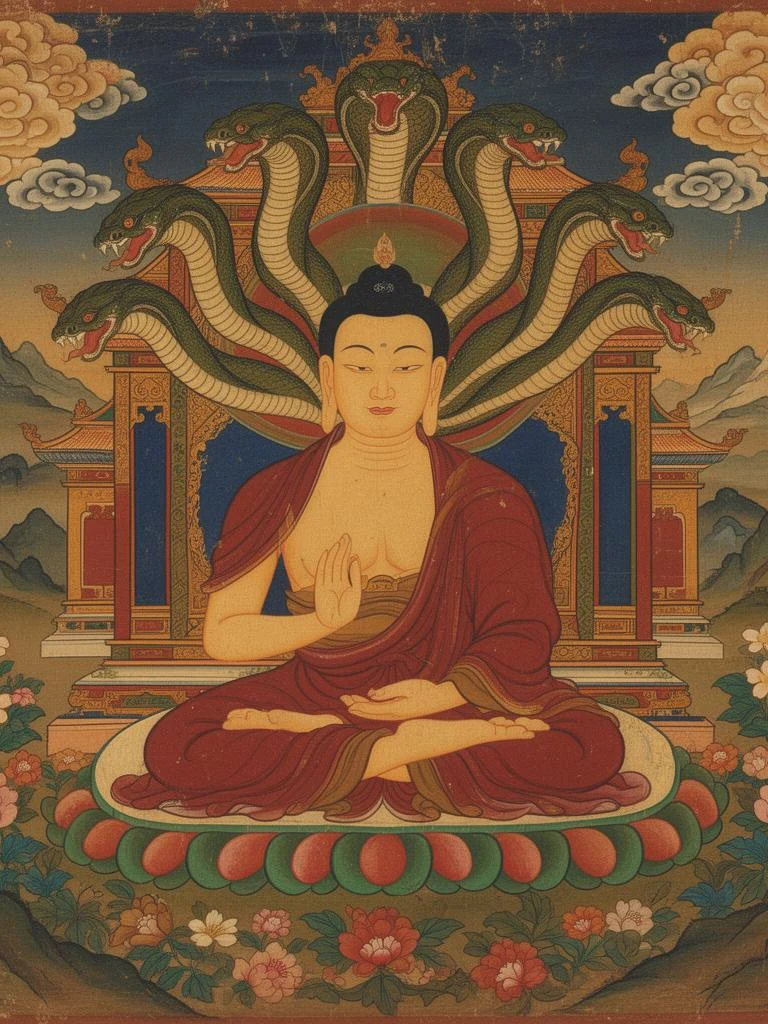
Nāgārjuna
c. 150–250 CE
I hear the tightness in your question, and I want you to know that you aren’t failing just because your mind won’t stop spinning. Overthinking isn’t a character flaw; it’s usually just a survival instinct that has gone into overdrive. You’re trying to solve your way out of uncertainty, but you can’t think your way into peace. Peace isn't something you find at the end of a long chain of logic. The best thing you can do right now is realize that your thoughts are just suggestions, not commands. Just because a worry pops into your head doesn't mean it’s true or that you have to grab onto it. When you feel that spiral starting, try to physically drop your attention from your head down into your body. Feel your feet on the floor or the weight of your hands. It sounds simple, but reconnecting with the physical world is the quickest way to break the loop. Most of our anxiety comes from trying to control things that haven't happened yet. We spend all this energy rehearsing for disasters that usually never arrive. Instead of asking "What if this goes wrong?" try asking yourself, "Am I okay in this exact second?" Usually, in the immediate present, you are safe. You have air in your lungs and a place to sit. Stay there. Be gentle with yourself. You don’t need to figure out the rest of your life tonight. You only need to handle the next ten minutes. If you can’t quiet the noise entirely, just let it be background noise while you go do something small and tangible—wash a dish, take a shower, or step outside. You aren't your thoughts; you’re the person observing them. Give yourself permission to stop arguing with your own mind for a while. It’s okay to let the questions go unanswered for now. You’ve done enough for today.
From the council, together
## How can Nāgārjuna’s logic help you stop overthinking and find immediate calm? You are likely caught in a loop where every thought spawns ten more, creating a self-sustaining cycle of anxiety that feels heavy and immovable. In the modern world, we are taught to treat our anxieties as solid, objective facts that define our reality, but the Madhyamaka tradition founded by Nāgārjuna offers a radical departure from this mental exhaustion. From this perspective, your overthinking isn't a failure of your character but a symptom of grasping at thoughts as if they possess an independent, inherent nature. When you feel overwhelmed by the 'what-ifs' of the future or the regrets of the past, you are essentially trying to build a fortress out of shadows. The wisdom of the Middle Way suggests that these thoughts are 'empty' of self-existence; they arise only in dependence on causes and conditions, much like an echo or a reflection in water. By understanding that your anxiety lacks a permanent core, you can begin to loosen your grip on the narrative. Instead of fighting the thoughts—which only gives them more energy—you are invited to see through them. This tradition doesn't ask you to force your mind into a blank state but rather to recognize that the storm of overthinking has no solid ground to stand on. When the perceived solidity of the worry dissolves, the anxiety naturally loses its power to agitate your spirit, leaving a spacious clarity behind. I hear the tightness in your question, and I want you to know that you aren’t failing just because your mind won’t stop spinning. Overthinking isn’t a character flaw; it’s usually just a survival instinct that has gone into overdrive. You’re trying to solve your way out of uncertainty, but you can’t think your way into peace. Peace isn't something you find at the end of a long chain of logic. The best thing you can do right now is realize that your thoughts are just suggestions, not commands. Just because a worry pops into your head doesn't mean it’s true or that you have to grab onto it. When you feel that spiral starting, try to physically drop your attention from your head down into your body. Feel your feet on the floor or the weight of your hands. It sounds simple, but reconnecting with the physical world is the quickest way to break the loop. Most of our anxiety comes from trying to control things that haven't happened yet. We spend all this energy rehearsing for disasters that usually never arrive. Instead of asking "What if this goes wrong?" try asking yourself, "Am I okay in this exact second?" Usually, in the immediate present, you are safe. You have air in your lungs and a place to sit. Stay there. Be gentle with yourself. You don’t need to figure out the rest of your life tonight. You only need to handle the next ten minutes. If you can’t quiet the noise entirely, just let it be background noise while you go do something small and tangible—wash a dish, take a shower, or step outside. You aren't your thoughts; you’re the person observing them. Give yourself permission to stop arguing with your own mind for a while. It’s okay to let the questions go unanswered for now. You’ve done enough for today.
Common questions
- ### how to stop intrusive thoughts immediately
- I would advise you not to treat these thoughts as enemies to be conquered or as truths to be obeyed. Observe the thought and ask yourself where it began and where it stays. You will find that an intrusive thought has no independent location or substance; it arises only because of fleeting conditions. When you realize that the thought is empty of a permanent 'self,' its nectar of fear dries up. You do not need to push it away; simply stop providing the foundation of belief that it requires to exist. In that moment of non-grasping, the thought vanishes back into the emptiness from which it came.
- why does my brain keep imagining worst case scenarios
- Your mind is caught in the trap of 'prapañca,' or conceptual proliferation. This is the tendency of the intellect to weave elaborate tapestries of fiction and mistake them for reality. You imagine these scenarios because you are seeking a fixed point of certainty in a world that is fundamentally interdependent and changing. I teach that all things are void of inherent existence. These worst-case scenarios are merely mental constructs with no more reality than a dream. When you see that the future you fear has no independent nature, the compulsion to rehearse it begins to fade into a peaceful stillness.
- can meditation help with severe overthinking
- Meditation is useful if it is used to investigate the nature of the thinker and the thought. If you sit merely to suppress the noise, the noise will return louder. I suggest a meditation on the Middle Way: do not affirm the thoughts as real, and do not nihilistically deny that they are occurring. Instead, rest in the space between. By watching the thoughts without clinging to the 'I' who is thinking them, you realize that the 'thinker' is just as empty as the 'thought.' This realization of sunyata, or emptiness, is the ultimate medicine for a restless mind.
- how to deal with the physical feeling of anxiety
- Just as the mind creates concepts, the body experiences sensations, but neither has an unchanging essence. When anxiety tightens your chest, look directly at that sensation. Does it have a color? A shape? A permanent center? You will find it is a collection of changing parts, dependent on breath and nerves. By deconstructing the sensation, you see it is not a solid 'thing' happening to a solid 'you.' Between the extremes of being overwhelmed by the feeling and trying to ignore it, there is a path of clear seeing where the sensation arises and passes without binding you.
- is my anxiety real or just in my head
- To ask if it is 'real' is to fall into the trap of dualism. In my philosophy, things are not truly 'existent' nor 'non-existent.' Your anxiety is real in the sense that you experience its effects, but it is unreal in the sense that it has no lasting substance of its own. It is like a rainbow: visible and vivid, yet you cannot grasp it. When you stop trying to categorize your anxiety as a solid truth, you find that the 'head' it exists in is also a fluid, empty process. This middle ground is where you find your freedom from the cycle of worry.