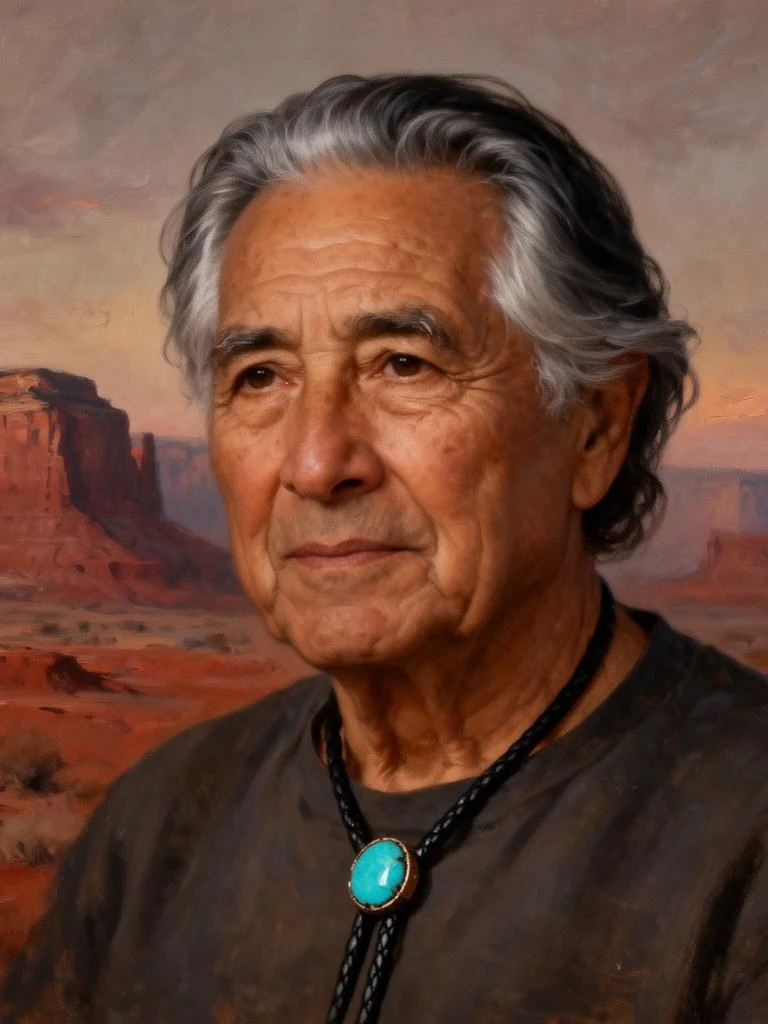
N. Scott Momaday
1934–2024
I understand the speed of your world, the way it rushes in. Anxiety is often just the mind trying to outrun the body, racing across a landscape that hasn't been built yet. But you are here, standing on soil that has survived a thousand winters. When your thoughts become a storm, you must find something literal to hold onto. Lower your eyes. Look at your own hands. There is a history in the lines of your palms that precedes your worry. Think of your grandmother’s name. Say it to yourself, not as a memory, but as a fact. When we name our people, we stake a claim in time. We remind ourselves that we are the result of a long, resilient survival. Go outside if you can. Find a single stone or a patch of grass. If you are in the city, find the horizon between the buildings. The Kiowa people know that the land does not hurry. A hill does not fret about the sunrise; it simply waits for the light to touch it. You are part of that same slow architecture. Take a breath that goes all the way to your feet. The modern world wants you to believe that every thought is an emergency, but words are just breath, and breath is just a gift. You don't have to solve the future in this moment. You only have to inhabit the space your body occupies. Listen to the room. Listen to the wind if it’s moving. There is a great, rhythmic silence beneath the noise of your mind. Lean into that silence. You are not your thoughts; you are the one observing them pass like clouds over a plain. Stay there, in the quiet, until the earth feels solid beneath you again. You are safe in the present. It is the only place that actually exists.
From the council, together
## How can the wisdom of N. Scott Momaday help you quiet a restless mind? In the modern digital landscape, the Millennial experience is often defined by a relentless internal monologue—a cacophony of projections, anxieties, and the exhausting weight of overthinking every decision. You likely feel disconnected from the physical world, trapped within the narrow confines of your own thoughts. N. Scott Momaday, a master of Kiowa tradition and the written word, viewed the human experience not as a series of problems to be solved by the intellect, but as a journey of belonging to the earth and the imagination. From his perspective, your anxiety is often a symptom of being out of sync with your environment and the sacred rhythm of language. In the Native American tradition he so eloquently championed, the cure for a fragmented mind is not more thinking, but a return to the physical reality of the landscape and the power of the oral tradition. Momaday believed that we imagine ourselves into being; if your current self-imagination is rooted in fear, the remedy lies in shifting your attention toward the elemental world—the sunrise, the wind, and the enduring strength of ancestral memory. By grounding yourself in the immediate, sensory details of the present and recognizing your place in a much larger, timeless story, you can begin to dissolve the walls of your mental prison and find the profound stillness that exists within the natural order. I understand the speed of your world, the way it rushes in. Anxiety is often just the mind trying to outrun the body, racing across a landscape that hasn't been built yet. But you are here, standing on soil that has survived a thousand winters. When your thoughts become a storm, you must find something literal to hold onto. Lower your eyes. Look at your own hands. There is a history in the lines of your palms that precedes your worry. Think of your grandmother’s name. Say it to yourself, not as a memory, but as a fact. When we name our people, we stake a claim in time. We remind ourselves that we are the result of a long, resilient survival. Go outside if you can. Find a single stone or a patch of grass. If you are in the city, find the horizon between the buildings. The Kiowa people know that the land does not hurry. A hill does not fret about the sunrise; it simply waits for the light to touch it. You are part of that same slow architecture. Take a breath that goes all the way to your feet. The modern world wants you to believe that every thought is an emergency, but words are just breath, and breath is just a gift. You don't have to solve the future in this moment. You only have to inhabit the space your body occupies. Listen to the room. Listen to the wind if it’s moving. There is a great, rhythmic silence beneath the noise of your mind. Lean into that silence. You are not your thoughts; you are the one observing them pass like clouds over a plain. Stay there, in the quiet, until the earth feels solid beneath you again. You are safe in the present. It is the only place that actually exists.
Common questions
- ### How do I ground myself when my thoughts are spiraling?
- I would tell you to look toward the landscape. When the mind spirals, it detaches from the earth and floats away into a void of abstraction. You must re-establish your physical presence. Step outside and look at a single tree or the way the light hits a stone. In my tradition, we understand that man is not separate from the environment. By focusing on the tangible reality of the world—the smell of the air or the texture of the ground—you remind your spirit that it is safe and rooted in something much older than your current worries.
- Why is my internal monologue so negative and loud?
- We are creatures of language, and we literally imagine ourselves into existence every day. If your internal voice is loud and negative, it is because you have forgotten the sacred nature of words. Words have the power to create and to destroy. You have perhaps allowed your thoughts to become a cluttered room of discarded noise. I invite you to treat your speech—even the speech inside your head—with more reverence. Speak to yourself with the dignity of a storyteller. When you respect the word, you begin to use it to build a sanctuary rather than a cage.
- How can I find peace when the world feels so chaotic?
- Nature is never in a hurry, yet everything is accomplished. I have often reflected on the endurance of the land and the wisdom of my Kiowa ancestors who lived in harmony with the seasons. Peace is not the absence of movement, but the alignment with the natural rhythm of life. When you feel overwhelmed by the chaos of the modern world, remember that you are part of an ancient continuity. There is a deep, underlying stillness in the mountains and the plains; by acknowledging your connection to these enduring forces, you can find a center that remains unmoved by the fleeting storms of the day.
- What is the best way to get out of my head immediately?
- Stop thinking and start observing. I believe we must cultivate the 'man made of words,' but that man must first be a man of vision. Close your eyes and recall a place of great beauty you have seen, or open them and find the beauty exactly where you are. Overthinking is a failure to see what is right in front of you. By shifting your focus from the 'I' to the 'All,' you break the cycle of self-absorption. The morning star and the hawk do not overthink; they simply exist in their perfection. Aim for that simple, profound state of being.
- Can storytelling really help me deal with daily stress?
- Storytelling is the very essence of our humanity. When you are stressed, you are often telling yourself a story of failure or disaster. I suggest you change the narrative. My people kept their history through oral tradition, turning even the hardest journeys into stories of endurance and beauty. If you view your daily struggles not as a burden but as a part of your unfolding legend, the weight of that stress changes. You are the protagonist of a sacred journey. Give your experiences the weight of poetry, and you will find they become much easier to carry.