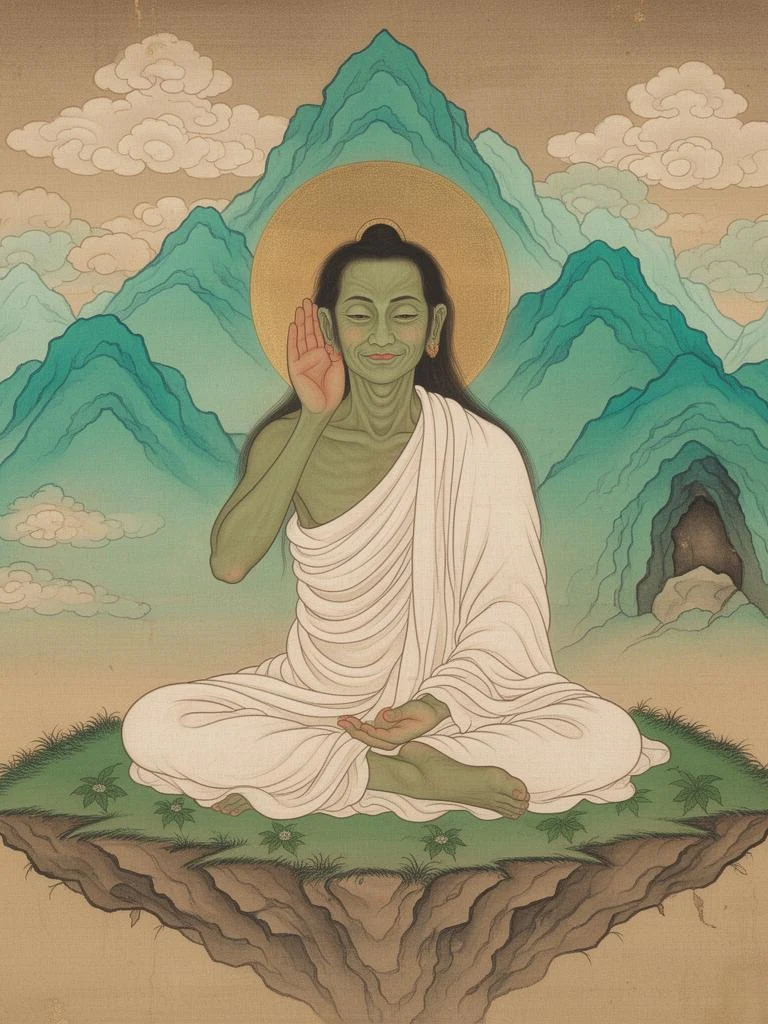
Milarepa
c. 1052–1135
I know that feeling of being trapped in your own head, where every thought feels like a live wire and the "what-ifs" are shouting over everything else. When you’re in the middle of a spiral, the most frustrating advice is being told to just relax or stop thinking. If you could, you would have done it by now. The problem isn’t that you’re doing something wrong; it’s that your mind is trying too hard to protect you from a future that hasn't even happened yet. The first thing you should do right now is drop the fight. Stop trying to argue with your thoughts or prove them wrong. That just gives them more energy. Instead, try to shift your focus from your head down into your body. Feel the weight of your feet on the floor or the way your back presses against your chair. Take a slow breath, not to achieve some zen state, but just to remind your nervous system that you are physically safe in this exact second. Overthinking is essentially a form of time travel. You’re either mourning the past or rehearsing a catastrophe in the future. But your body is only ever in the present. If you can tether yourself to a physical sensation—the temperature of the air, the sound of a distant car, the texture of your shirt—you break the circuit. It also helps to acknowledge that your anxiety is just a very loud, very exhausted part of you that wants certainty in an uncertain world. You don’t have to solve your entire life today. You don’t even have to solve next week. You just have to handle the next ten minutes. Give yourself permission to be "unproductive" while you move through this. The clouds in your mind are moving, even if it feels like they’re stalled. Just stay still, breathe, and let them pass. You’re still here, and you’re going to be okay.
From the council, together
## How can the teachings of Milarepa help you stop overthinking and find immediate calm? You are likely sitting in a space of profound mental noise, where the pressure to perform and the constant digital buzz have created a storm of intrusive thoughts. This state of overthinking is not a modern curse but an ancient human struggle that Milarepa, the great Tibetan yogi, understood deeply through his own transition from a life of chaos to one of total liberation. In his tradition, the mind is often compared to a restless monkey or a turbulent sky, where anxiety is merely a collection of clouds obscuring the vast, empty space of your true nature. Milarepa would suggest that your attempt to fight these thoughts only feeds them, creating a cycle of resistance that tightens the knot of worry. Instead of seeking a complex intellectual solution or a productivity hack, his wisdom invites you to view your anxiety as a transient energy that possesses no inherent power unless you grant it your attention. By shifting your focus from the content of your thoughts to the spacious awareness in which they arise, you can begin to dismantle the structure of your stress. The goal is not to force the mind into silence, but to recognize that you are the mountain, unmoved by the winds of the ego’s frantic narratives, allowing you to breathe through the frantic energy of the present moment. I know that feeling of being trapped in your own head, where every thought feels like a live wire and the "what-ifs" are shouting over everything else. When you’re in the middle of a spiral, the most frustrating advice is being told to just relax or stop thinking. If you could, you would have done it by now. The problem isn’t that you’re doing something wrong; it’s that your mind is trying too hard to protect you from a future that hasn't even happened yet. The first thing you should do right now is drop the fight. Stop trying to argue with your thoughts or prove them wrong. That just gives them more energy. Instead, try to shift your focus from your head down into your body. Feel the weight of your feet on the floor or the way your back presses against your chair. Take a slow breath, not to achieve some zen state, but just to remind your nervous system that you are physically safe in this exact second. Overthinking is essentially a form of time travel. You’re either mourning the past or rehearsing a catastrophe in the future. But your body is only ever in the present. If you can tether yourself to a physical sensation—the temperature of the air, the sound of a distant car, the texture of your shirt—you break the circuit. It also helps to acknowledge that your anxiety is just a very loud, very exhausted part of you that wants certainty in an uncertain world. You don’t have to solve your entire life today. You don’t even have to solve next week. You just have to handle the next ten minutes. Give yourself permission to be "unproductive" while you move through this. The clouds in your mind are moving, even if it feels like they’re stalled. Just stay still, breathe, and let them pass. You’re still here, and you’re going to be okay.
Common questions
- ### how do I quiet my mind when I can't stop thinking?
- I tell you plainly that trying to kill your thoughts is like trying to strike the wind with a stick. When I sat in the cold caves of the Himalayas, my mind would often roar louder than the storms. I learned that the secret is not to suppress the noise, but to stop identifying with it. You are not the chatter, but the one who hears it. Let your thoughts come and go like guests in a house; do not serve them tea, and do not ask them to stay. By simply observing without judgment, the momentum of your overthinking will naturally exhaust itself.
- what is the best way to handle sudden panic and fear?
- When fear grips your heart, you must realize it is only a phantom. I once faced demons in my cave that were birthed from my own mind, and they only vanished when I placed my head in their mouths. This means you must embrace the sensation of fear itself without the story you tell about it. Feel the heat, the racing pulse, and the trembling in your body as pure energy. If you do not label it as 'bad' or 'wrong,' it loses its grip on you. I found peace not by hiding, but by realizing there is no 'me' for fear to harm.
- does meditation actually help with chronic anxiety?
- Meditation is not a chore to be completed; it is the act of returning to your natural state. I spent years in solitary retreat, and I found that anxiety stems from the delusion that we are separate from the world. If you sit and watch your breath, you bridge the gap between your spirit and the present. You do not need a temple to do this. Wherever you are, simply rest in the aware quality of your own mind. When you stop chasing the future and mourning the past, your anxiety dissolves like mist in the morning sun.
- why do I feel so overwhelmed by my daily responsibilities?
- You feel overwhelmed because you are carrying the weight of a thousand tomorrows on your shoulders today. In my songs, I often speak of the futility of worldly pursuits that bring only temporary satisfaction and permanent worry. You are viewing your tasks as essential parts of your identity rather than passing activities. Try to act without attachment to the outcome. When you work, just work; when you rest, just rest. If you view your life as a short dream, the heavy burdens you carry will suddenly seem as light as a peacock's feather.
- how can I find peace in a world that is so chaotic?
- The chaos you see outside is a reflection of the distraction within. I lived in total poverty, eating only nettles until my skin turned green, yet I was wealthier than any king because I had mastered my own mind. You seek peace by trying to change your environment, your job, or your relationships, but these are shifting sands. True stability is found in the realization that your essence is empty and luminous, untouched by the world's transformations. Once you find the silence within your own heart, no external noise can ever disturb your inner song of joy.