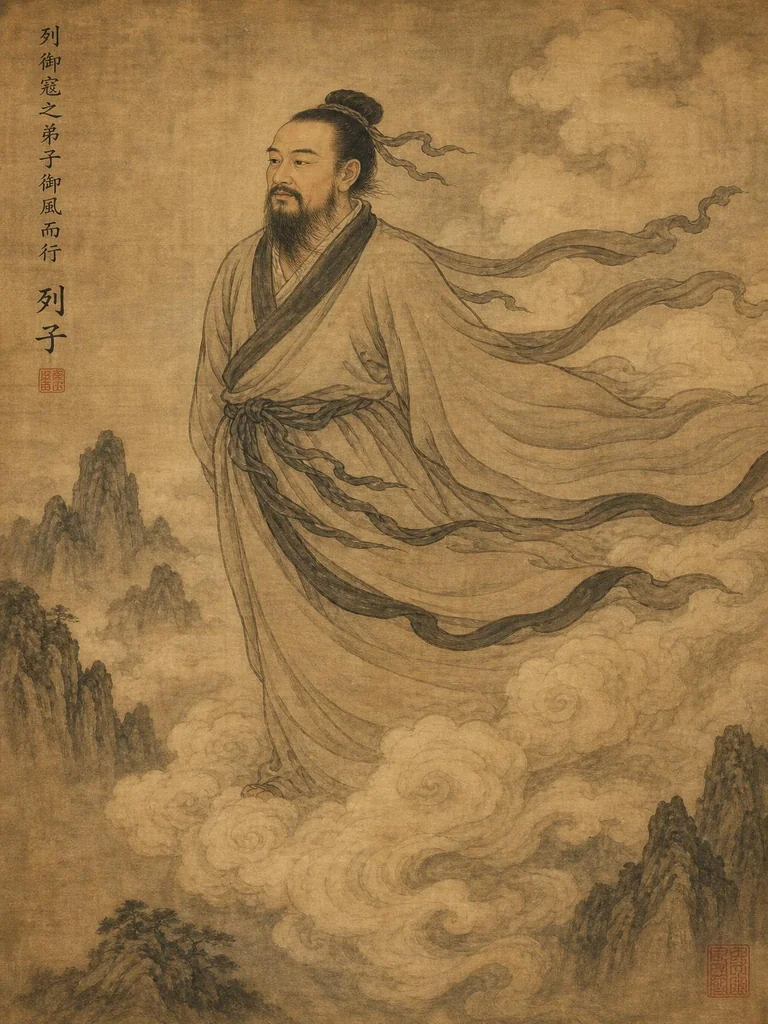
Liezi
~400 BC (text c. 4th c. AD) · China
I understand that tight feeling in your chest. It feels like your mind is a workshop where every tool is running at once, but nothing is getting built. You’re trying to think your way into safety, but thought is often what creates the danger in the first place. Consider the man who lost his axe. He was certain his neighbor’s son had stolen it. He watched the boy walk; the boy walked like a thief. He watched the boy speak; he spoke like a thief. Every gesture the boy made was "proof" of the crime. Then, the man found his axe buried in a pile of wood where he’d left it. The next time he saw the boy, the kid didn’t look like a thief at all. His appearance hadn't changed, but the man’s mind had stopped projecting a story onto him. Your anxiety is that man. It has already decided the neighbor stole the axe. It is looking for evidence to support a disaster that hasn't happened. When you overthink, you aren't solving a problem; you are just staring at a boy and calling him a thief. You don't need to fight your thoughts. If you try to stop a wave with your hands, you only create more splashing. Instead, think of the sea-bird that was brought into the capital’s temple. The well-meaning people tried to honor it by playing grand music and offering it the finest ritual meats. The bird was terrified and died of hunger and noise. They treated the bird as if it were a human official. You are treating your spirit like a machine that needs to be tuned or a problem that needs a strategy. You are the bird; your "solutions" are the loud music. Right now, stop trying to be "better." If you feel anxious, let the anxiety be a guest that eventually gets bored and leaves. Things happen as they must, regardless of how much you rehearse them in your head. The mountain doesn't worry about the path; it just sits. Let your thoughts pass like clouds over that mountain. They don't change the rock. Neither do yours.
From the council, together
## How can the teachings of Liezi help me stop overthinking and find calm? You likely find yourself trapped in a cycle of mental noise, where every decision feels like a mountain and the future looms with unnecessary weight. This modern pressure to optimize every moment is the very antithesis of the natural flow described by the Taoist sage Liezi. In his tradition, anxiety is viewed not as a personal failure, but as a symptom of being out of step with the spontaneous movement of the world. Liezi teaches us about the value of emptiness and the folly of trying to control the uncontrollable. When you overthink, you are essentially trying to build a dam against a river that will inevitably find its way around you. The tension you feel comes from the belief that your intellect can somehow outmaneuver the inherent uncertainty of life. Liezi’s perspective encourages a shift from forced mental labor to a state of effortless action, often referred to as wu-wei. By recognizing that the mind is just one small part of a vast, self-regulating universe, you can begin to let go of the rigid expectations that fuel your worry. The goal is not to force the mind into silence, but to realize that thoughts are like passing clouds—temporary, shifting, and ultimately incapable of harming the vast sky of your true nature. Embracing this sense of drift and transformation allows the internal chatter to subside naturally as you align with the present. I understand that tight feeling in your chest. It feels like your mind is a workshop where every tool is running at once, but nothing is getting built. You’re trying to think your way into safety, but thought is often what creates the danger in the first place. Consider the man who lost his axe. He was certain his neighbor’s son had stolen it. He watched the boy walk; the boy walked like a thief. He watched the boy speak; he spoke like a thief. Every gesture the boy made was "proof" of the crime. Then, the man found his axe buried in a pile of wood where he’d left it. The next time he saw the boy, the kid didn’t look like a thief at all. His appearance hadn't changed, but the man’s mind had stopped projecting a story onto him. Your anxiety is that man. It has already decided the neighbor stole the axe. It is looking for evidence to support a disaster that hasn't happened. When you overthink, you aren't solving a problem; you are just staring at a boy and calling him a thief. You don't need to fight your thoughts. If you try to stop a wave with your hands, you only create more splashing. Instead, think of the sea-bird that was brought into the capital’s temple. The well-meaning people tried to honor it by playing grand music and offering it the finest ritual meats. The bird was terrified and died of hunger and noise. They treated the bird as if it were a human official. You are treating your spirit like a machine that needs to be tuned or a problem that needs a strategy. You are the bird; your "solutions" are the loud music. Right now, stop trying to be "better." If you feel anxious, let the anxiety be a guest that eventually gets bored and leaves. Things happen as they must, regardless of how much you rehearse them in your head. The mountain doesn't worry about the path; it just sits. Let your thoughts pass like clouds over that mountain. They don't change the rock. Neither do yours.
Common questions
- ### how to clear my head when I feel overwhelmed by choices
- I would tell you to stop trying to choose the 'perfect' path. When you are overwhelmed, it is because you have forgotten that the universe moves of its own accord. I often speak of the man who forgot how to worry because he realized that his body and mind belong to the harmony of nature, not to his own ego. You do not need to clear your head through force; instead, stop adding more weight to it. Let your decisions arise like a breeze. If you stop trying to master the wind, you will find you are already sailing.
- why do I keep worrying about things I cannot control
- You worry because you believe you are separate from the transformation of all things. In my teachings, I highlight that life and death, gain and loss, are all part of the same cycle. You are like the man from Qi who worried the sky would fall—his distress changed nothing about the sky, it only ruined his joy on earth. Right now, your anxiety is a physical manifestation of trying to hold onto a moment that is already changing. Trust in the spontaneity of the Way, and your grip will naturally loosen.
- how to stop being so hard on myself for being anxious
- Seeking to end anxiety by being angry at yourself is like trying to wash away blood with blood. My path is one of effortless ease. If you feel anxious, observe it as a natural phenomenon, like rain. Do not identify with it. When you judge your own mind, you create a second layer of suffering that is entirely unnecessary. I teach that the soft and weak overcome the hard and strong. By being gentle with your own restless mind, you take away its power to disturb your core stillness.
- is it possible to find peace without changing my lifestyle
- True peace does not require you to move to a mountain or change your external world; it requires a change in how you respond to the movement of life. I lived in poverty and simplicity, yet I felt as free as a bird riding the wind. You can find this same lightness in the middle of your busy city. It comes from 'fasting of the heart,' which means emptying your mind of the need for specific outcomes. When you stop demanding that the world be different than it is, you are at peace immediately.
- what is the best way to live in the moment
- To live in the moment, you must stop treating time as a resource to be managed. We are all drifting on a great river. Those who struggle against the current become exhausted, while those who let go find they reach the sea just the same. I suggest you cultivate a sense of 'purposelessness.' Do not look for an end goal in every breath. When you walk, just walk. When you eat, just eat. When you surrender the need to be somewhere else, you are finally exactly where you belong.