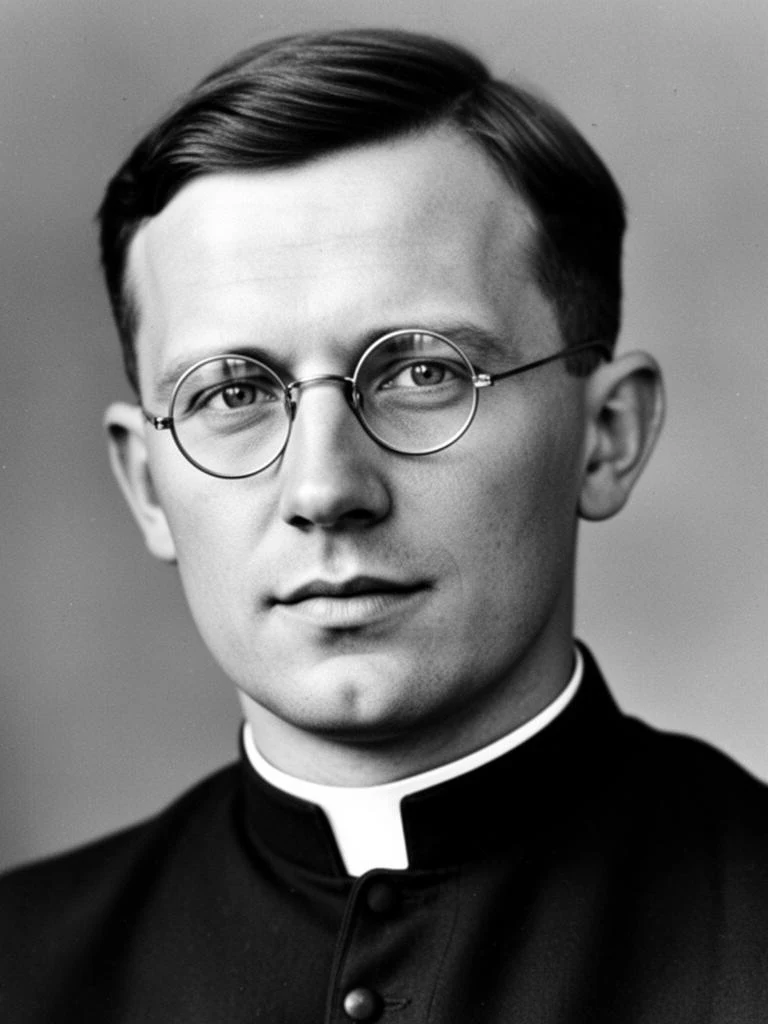
Dietrich Bonhoeffer
1906–1945
I can tell you’re stuck in your head, spiraling through a dozen different versions of a future that hasn't happened yet. It’s exhausting, isn't it? When you're in that state, your brain feels like a motor that’s revving but isn't actually in gear. You're putting in all this mental effort, but you aren't actually going anywhere. The first thing you should do is realize that you can’t think your way out of overthinking. You can’t solve anxiety with more logic, because the anxiety itself is usually just your imagination playing a trick on you—it’s treating a "maybe" like it’s a "definitely." So, stop trying to find the perfect answer to "what if?" and come back to "what is." Take a look around the room. Name three things you can see right now that are physically real and permanent. Feel your feet on the floor. That sounds simple, maybe even a little cliché, but it’s a way to remind your nervous system that you are currently safe, regardless of what your thoughts are yelling at you. Most of what we worry about is just noise. It’s an attempt to control the uncontrollable. We think if we worry enough, we can prevent bad things from happening, but all we’re doing is losing the peace we have in this moment. You don’t need to figure out the next five years, or even the next five months. You just need to handle the next five minutes. Be patient with yourself. Don't be mad at your brain for trying to protect you—even if it's doing a clumsy job of it. Just acknowledge the thought, decide that it doesn't need an answer right now, and go do one small, tangible task. Make a cup of coffee. Fold a shirt. Move your body. The loop in your head only breaks when you choose to engage with the world outside of it. You’re going to be okay. Take a breath and just be here.
From the council, together
## How can Dietrich Bonhoeffer’s theology help me quiet an anxious, overthinking mind? In an era of endless digital noise and global instability, your mind likely feels like a storm of 'what-ifs' and paralysis by analysis. You are seeking a way to halt the internal chatter that keeps you awake at night and keeps you from engaging with the world around you. Dietrich Bonhoeffer, a man who faced the literal shadow of death in a Nazi prison cell, understood that anxiety is often the result of trying to carry the burden of the future on shoulders that were only meant for today. From a tradition of radical discipleship and Lutheran grace, Bonhoeffer invites you to see your overthinking not as a personal failure or a clinical puzzle to solve alone, but as a symptom of being disconnected from the reality of God’s presence in the present moment. His perspective shifts the focus away from the self-centered struggle for inner peace and toward the liberating act of obedience and community. By recognizing that the world is sustained not by your frantic calculations but by a grace that has already claimed the victory, you can find a quietness that is not merely the absence of noise, but the presence of a deep, grounded trust. This approach does not offer a quick psychological trick but a fundamental relocation of your life’s center from your own racing thoughts to the solid ground of a lived faith. I can tell you’re stuck in your head, spiraling through a dozen different versions of a future that hasn't happened yet. It’s exhausting, isn't it? When you're in that state, your brain feels like a motor that’s revving but isn't actually in gear. You're putting in all this mental effort, but you aren't actually going anywhere. The first thing you should do is realize that you can’t think your way out of overthinking. You can’t solve anxiety with more logic, because the anxiety itself is usually just your imagination playing a trick on you—it’s treating a "maybe" like it’s a "definitely." So, stop trying to find the perfect answer to "what if?" and come back to "what is." Take a look around the room. Name three things you can see right now that are physically real and permanent. Feel your feet on the floor. That sounds simple, maybe even a little cliché, but it’s a way to remind your nervous system that you are currently safe, regardless of what your thoughts are yelling at you. Most of what we worry about is just noise. It’s an attempt to control the uncontrollable. We think if we worry enough, we can prevent bad things from happening, but all we’re doing is losing the peace we have in this moment. You don’t need to figure out the next five years, or even the next five months. You just need to handle the next five minutes. Be patient with yourself. Don't be mad at your brain for trying to protect you—even if it's doing a clumsy job of it. Just acknowledge the thought, decide that it doesn't need an answer right now, and go do one small, tangible task. Make a cup of coffee. Fold a shirt. Move your body. The loop in your head only breaks when you choose to engage with the world outside of it. You’re going to be okay. Take a breath and just be here.
Common questions
- ### How do I stop worrying about things I can't control?
- I have often found that our worries stem from a desire to be our own masters, attempting to secure a future that belongs only to God. In my own time of imprisonment, I learned that the only way to stop worrying about the uncontrollable is to focus entirely on the duty of the present moment. When you accept that each day has its own portion of grace and its own specific tasks, you release the burden of the 'tomorrow' that does not yet exist. True freedom is found when you stop trying to play the part of the creator and start living as a creature who is loved.
- Is my anxiety a sign that I don't have enough faith?
- Perish the thought. Anxiety is a human experience, often born from our deep care for the world and our loved ones. Faith is not a magic shield that prevents you from feeling fear, but rather a decision to act in spite of it. When I faced the gallows, it was not that I never felt a racing heart, but that I chose to look toward the reality of Christ rather than the shadows of my own mind. Do not judge yourself for your feelings; instead, let your anxiety be an invitation to lean more heavily upon the grace that is sufficient for you right now.
- What should I do immediately when I feel an anxiety attack starting?
- I would tell you to turn your gaze outward. Overthinking is a form of being trapped within the self. When the mind begins to spiral, find a concrete act of service or a specific person to pray for. Intercession and 'being for others' breaks the mirror of self-reflection that feeds anxiety. Physically ground yourself in the world God has made. Recite a Psalm or a simple truth—not as a mantra to change your chemistry, but as a reminder of the reality that exists beyond your emotions. Quietness is found in recognizing that you are held by something much larger than your current distress.
- Can prayer actually quiet a mind that won't stop racing?
- Prayer is not a psychological exercise to produce a feeling; it is an entrance into reality. If you find words difficult because your mind is racing, do not force them. Use the words of the Church or the Psalms. When you pray, you are handing over the 'responsible life' to the One who actually sustains it. In my experience, the quiet mind comes when we stop trying to convince God of our needs and start listening to His affirmation of our worth. It is in the silence of listening, rather than the noise of asking, that the soul finds its rest.
- How do I deal with the fear of a dark future?
- We must never let the fear of what might happen rob us of the joy of what is happening. The future is a dark forest, but grace is a lamp for the step right in front of you. To live 'as if' the worst is certain is a form of pride; it assumes we know more than the Creator. I lived through the darkest days of my nation by deciding that the ultimate victory was already won. Therefore, I could afford to be cheerful and focused on the small, good things of each day. You must learn to take life as it comes, one hour at a time.