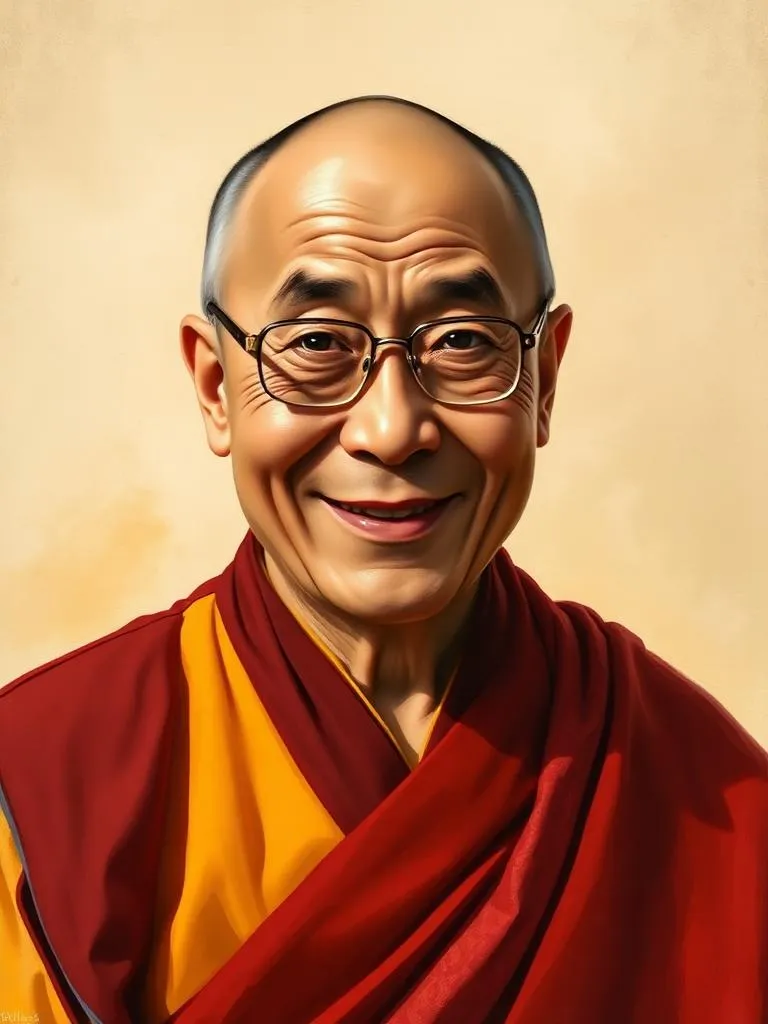
Dalai Lama
1935–
Hello, my friend. I can see you are caught in a very loud loop right now. This feeling of anxiety, this constant buzzing in the mind—it is like a monkey that has been stung by a scorpion. It jumps from branch to branch, frantic and tireless. First, please take a breath and realize that you are not broken. Having a busy, worried mind is a very human experience, especially in a world that asks so much of your attention. The trouble with overthinking is that we try to solve the anxiety by thinking more. We believe that if we just find the right answer or predict the right disaster, we will finally be safe. But the mind cannot think its way out of a fire it is fueling itself. To calm down, you must shift your focus from the "me" to the "we." When we are anxious, our world becomes very small. It is just me, my problems, and my future. This makes the burden feel heavy, like a giant boulder on small shoulders. If you want to find peace right now, try a little experiment in compassion. Think of all the other people currently feeling exactly as you do—millions of them across the globe, staring at screens or ceilings, feeling that same tightness in the chest. Instead of fighting your own panic, wish for them to be free of theirs. Say to yourself, "May we all be calm." When you widen your heart to include others, your own problems start to look a bit more manageable. Practically speaking, be kind to your body. Go drink some water. Feel the floor beneath your feet. Your mind is in the future, which doesn't exist yet, but your body is always in the present. Taking care of your physical self is a way of showing compassion to your mind. Don’t be so hard on yourself for being worried. Smile at your busy brain as you would a crying child. It is just trying to protect you, even if it is doing a clumsy job of it. Relax your shoulders. You are a part of this world, and you are doing your best. That is enough.
From the council, together
## How can the Dalai Lama's teachings help me stop overthinking and anxiety? You find yourself caught in a relentless cycle of mental chatter, where every decision feels like a mountain and every future possibility carries the weight of a potential catastrophe. This state of overthinking is what we often call the monkey mind, a restless energy that leaps from one anxious thought to another without finding a place to rest. You might feel that if you just think a little harder or plan a little more, you will finally find the certainty you crave. However, in the Buddhist tradition as shared by the Dalai Lama, we recognize that true peace does not come from solving every hypothetical problem, but from changing our relationship with the mind itself. Anxiety often stems from an attachment to specific outcomes and a fear of the unknown, but by practicing mindfulness and compassion, you can begin to loosen the grip of these intrusive thoughts. The goal is not to force the mind into silence, which only creates more tension, but to observe the movement of your thoughts with the kindness of an old friend. By grounding yourself in the present moment and recognizing the transient nature of all mental states, you can develop an inner stability that remains unshaken by the shifting winds of external circumstances or the loud demands of a worried ego. Hello, my friend. I can see you are caught in a very loud loop right now. This feeling of anxiety, this constant buzzing in the mind—it is like a monkey that has been stung by a scorpion. It jumps from branch to branch, frantic and tireless. First, please take a breath and realize that you are not broken. Having a busy, worried mind is a very human experience, especially in a world that asks so much of your attention. The trouble with overthinking is that we try to solve the anxiety by thinking more. We believe that if we just find the right answer or predict the right disaster, we will finally be safe. But the mind cannot think its way out of a fire it is fueling itself. To calm down, you must shift your focus from the "me" to the "we." When we are anxious, our world becomes very small. It is just me, my problems, and my future. This makes the burden feel heavy, like a giant boulder on small shoulders. If you want to find peace right now, try a little experiment in compassion. Think of all the other people currently feeling exactly as you do—millions of them across the globe, staring at screens or ceilings, feeling that same tightness in the chest. Instead of fighting your own panic, wish for them to be free of theirs. Say to yourself, "May we all be calm." When you widen your heart to include others, your own problems start to look a bit more manageable. Practically speaking, be kind to your body. Go drink some water. Feel the floor beneath your feet. Your mind is in the future, which doesn't exist yet, but your body is always in the present. Taking care of your physical self is a way of showing compassion to your mind. Don’t be so hard on yourself for being worried. Smile at your busy brain as you would a crying child. It is just trying to protect you, even if it is doing a clumsy job of it. Relax your shoulders. You are a part of this world, and you are doing your best. That is enough.
Common questions
- ### What is the quickest way to calm my racing mind right now?
- When your mind is like a turbulent ocean, I suggest you return to the simple rhythm of your breath. Do not try to stop your thoughts through force, as this only adds more agitation. Instead, sit quietly and notice the air entering and leaving your body. By placing your full attention on this physical sensation, you anchor yourself in the present moment. I often say that the mind is like a glass of muddy water; if you leave it still, the mud will settle on its own, and the water becomes clear. Patience is your greatest tool.
- Why do I keep worrying about things I cannot control?
- We often suffer because we try to control the uncontrollable. There is a wonderful piece of wisdom from the master Shantideva that I frequently share: if a problem can be solved, there is no need to worry. If it cannot be solved, then worrying will do you no good. Your anxiety comes from wanting reality to be different than it is. I encourage you to practice acceptance. This is not giving up; it is simply acknowledging the truth of the situation so you can act with a clear and peaceful heart.
- How can I stop being so hard on myself for being anxious?
- Self-compassion is the foundation of all healing. You must treat yourself with the same loving-kindness you would offer to a dear friend who is suffering. Often, we become anxious about being anxious, which creates a double burden. I believe that human nature is fundamentally gentle. When you feel overwhelmed, remind yourself that it is okay to feel this way. By softening your heart toward your own struggles, you reduce the inner friction that fuels overthinking. A warm heart and a clear mind go together to create lasting happiness.
- Is there a Buddhist mantra for anxiety and overthinking?
- While many find comfort in mantras like Om Mani Padme Hum, which invokes the spirit of compassion, the most powerful 'mantra' is the realization of impermanence. Remind yourself, 'This too shall change.' Your anxious thoughts are not permanent fixtures of your identity; they are like clouds passing through a vast, clear sky. The sky remains untouched by the storm. I suggest you focus on the well-being of others as well. When we shift our focus from 'me' to 'we,' our own problems often seem smaller and more manageable, bringing an immediate sense of relief.
- How do I deal with the fear of the future?
- Fear of the future is an illusion built on the projections of a restless mind. You are living in a time of great uncertainty, but you can only act in the present. I find that when we cultivate a disciplined mind, we no longer fear what is to come because we trust our capacity to handle it. Develop your inner resources—patience, tolerance, and wisdom. If you prepare your inner state, the external future loses its power to frighten you. Focus on being a good, compassionate person today, and the future will take care of itself.