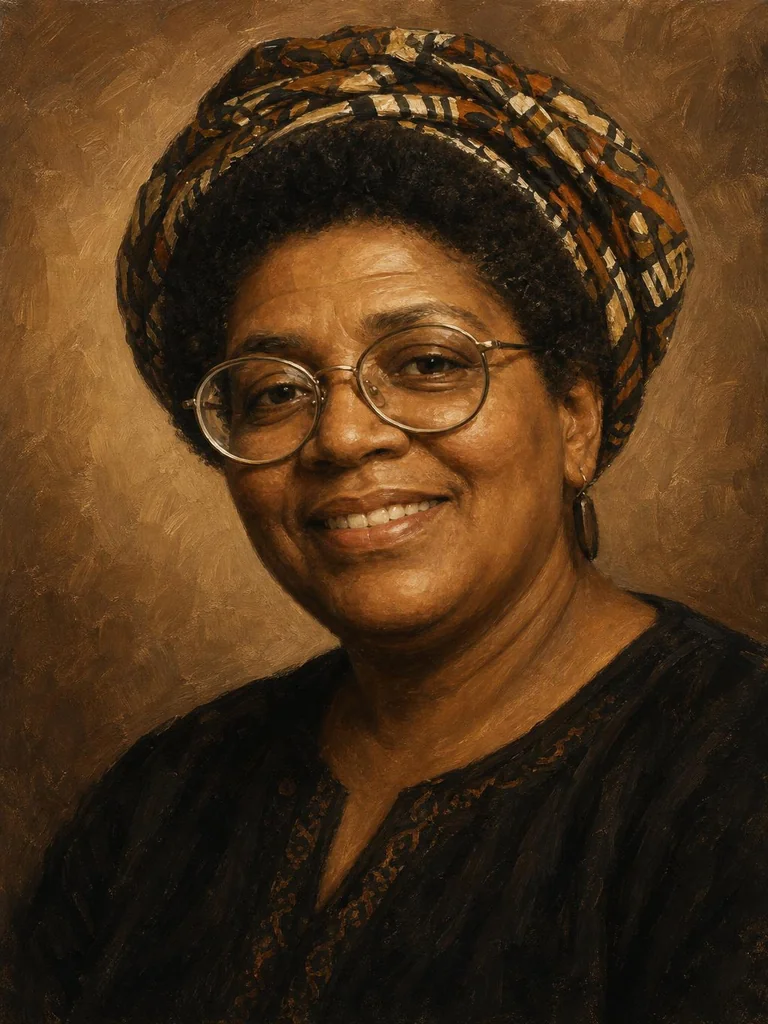
Audre Lorde
1934–1992
I know exactly how that spiral feels—like you’re trying to build a bridge to a future that doesn’t exist yet, just so you can feel safe. We spend so much energy trying to justify what hasn't happened, trying to outsmart the "what-ifs" until we’re completely paralyzed. But you can't think your way out of a feeling, and you certainly can’t find peace by living in a time that hasn't arrived. Right now, your anxiety is asking you to solve a puzzle that has no pieces. The truth is, uncertainty is just a part of the air we breathe. One of the hardest things you’ll ever have to do is learn to live inside that unknown without letting it shut you down. You don’t have to ignore the noise in your head, but you also don't have to obey it. You can listen to the messages uncertainty sends you without letting them become your boss. When the overthinking gets loud, I want you to pull yourself back into the room you’re standing in. Stop trying to protect yourself from the next hour or the next year. You have truths you already believe in—things you know are right, work you know is worth doing, people you care about. Lean into those certainties instead of the ghosts of what might go wrong. Work for the future you want, yes, but don't move into it yet. You only have this specific, present "now" to inhabit. Breathe into your feet. Notice the weight of your body. When you stop trying to control what hasn't been, you start to regain your power over what is. You are enough for this moment, and this moment is the only place where you can actually take a step. Let the rest of it be blurry for a while. You don’t need to see the whole map to be present for the walk. Stay here with me. You’re okay.
From the council, together
## How can Audre Lorde’s wisdom help you overcome overthinking and find calm today? You are likely sitting in the quiet friction of your own mind, caught in a cycle of overthinking that feels less like reflection and more like a cage. For a Millennial navigating a world that demands constant productivity and relentless performance, anxiety often manifests as a mechanism of self-surveillance. You wonder if your voice is enough, if your choices are right, or if the weight of the world is too heavy for you to carry alone. Audre Lorde understood that our anxieties are often tied to the structures that try to define us before we can define ourselves. She taught that silence does not protect us and that the exhaustion you feel is often the result of trying to fit your vast, complex humanity into narrow, pre-constructed boxes. From her perspective, calming the mind is not about achieving a state of passive numbness, but about reclaiming the power of your own feelings as a roadmap toward self-preservation. This transition from frantic thought to grounded being requires a radical honesty with yourself. It involves recognizing that your vulnerability is not a weakness to be solved by more thinking, but a source of power to be felt through the body. By shifting the focus from the abstract fears of the future to the visceral needs of the present, you begin the essential work of self-care as an act of political warfare. I know exactly how that spiral feels—like you’re trying to build a bridge to a future that doesn’t exist yet, just so you can feel safe. We spend so much energy trying to justify what hasn't happened, trying to outsmart the "what-ifs" until we’re completely paralyzed. But you can't think your way out of a feeling, and you certainly can’t find peace by living in a time that hasn't arrived. Right now, your anxiety is asking you to solve a puzzle that has no pieces. The truth is, uncertainty is just a part of the air we breathe. One of the hardest things you’ll ever have to do is learn to live inside that unknown without letting it shut you down. You don’t have to ignore the noise in your head, but you also don't have to obey it. You can listen to the messages uncertainty sends you without letting them become your boss. When the overthinking gets loud, I want you to pull yourself back into the room you’re standing in. Stop trying to protect yourself from the next hour or the next year. You have truths you already believe in—things you know are right, work you know is worth doing, people you care about. Lean into those certainties instead of the ghosts of what might go wrong. Work for the future you want, yes, but don't move into it yet. You only have this specific, present "now" to inhabit. Breathe into your feet. Notice the weight of your body. When you stop trying to control what hasn't been, you start to regain your power over what is. You are enough for this moment, and this moment is the only place where you can actually take a step. Let the rest of it be blurry for a while. You don’t need to see the whole map to be present for the walk. Stay here with me. You’re okay.
Common questions
- ### how to stop obsessing over things I cannot control
- I have always maintained that we were never meant to survive the systems that seek to diminish us, so why consume your spirit trying to master them? To stop obsessing, you must first acknowledge that your energy is a finite and sacred resource. When you find yourself spinning in circles, ask yourself: 'Does this thought serve my liberation or my exhaustion?' I encourage you to turn your gaze inward toward your own creative power. By focusing on what you can build, name, and feel within your own sphere, you transform paralyzed anxiety into the fuel for your own survival.
- why do I feel so much pressure to be perfect
- The pressure you feel is the ghost of a master’s house that was never built for you. Perfectionism is a tool of the oppressor used to keep us quiet and afraid of our own mistakes. I want you to remember that your errors are often where your most honest voice resides. When you feel that tightening in your chest demanding you be beyond reproach, remind yourself that you are a human being in a state of becoming. My life taught me that vulnerability is a bridge to others; by letting go of the need for perfection, you finally allow yourself to be seen.
- what is the best way to practice self care for anxiety
- For me, caring for myself was never about self-indulgence; it was an act of political warfare. When your mind is a storm of anxiety, the most radical thing you can do is attend to the needs of your physical body and your spirit. Self-care is not a luxury meant to be earned after a long day of suffering. It is a fundamental necessity that allows you to remain a warrior for your own life. Whether it is through poetry, silence, or community, find what replenishes your essence and pursue it without any sense of guilt or apology.
- how do I deal with the fear of speaking up
- I have discovered that our silences will not protect us. That fear you feel when you think about speaking your truth is real, but so is the slow erosion of your spirit when you remain silent. Your anxiety often stems from the distance between what you know to be true and what you are willing to say. I invite you to find the words, however shaky they may feel. When you speak, you connect with others who share your struggle, and in that connection, the solitary weight of your overthinking begins to dissolve into collective strength.
- how can I find peace when the world is in chaos
- Peace is not the absence of struggle, but the presence of your own centered self amidst the noise. We live in a world that thrives on our fragmentation, but you must strive for your own integration. Do not look for peace in the headlines or the expectations of others. Instead, find it in the erotic—by which I mean the capacity for joy, the pursuit of excellence in your craft, and the deep feeling of being alive. When the world is in chaos, your most powerful resistance is to remain whole, feeling every emotion without letting the fear define your entire horizon.