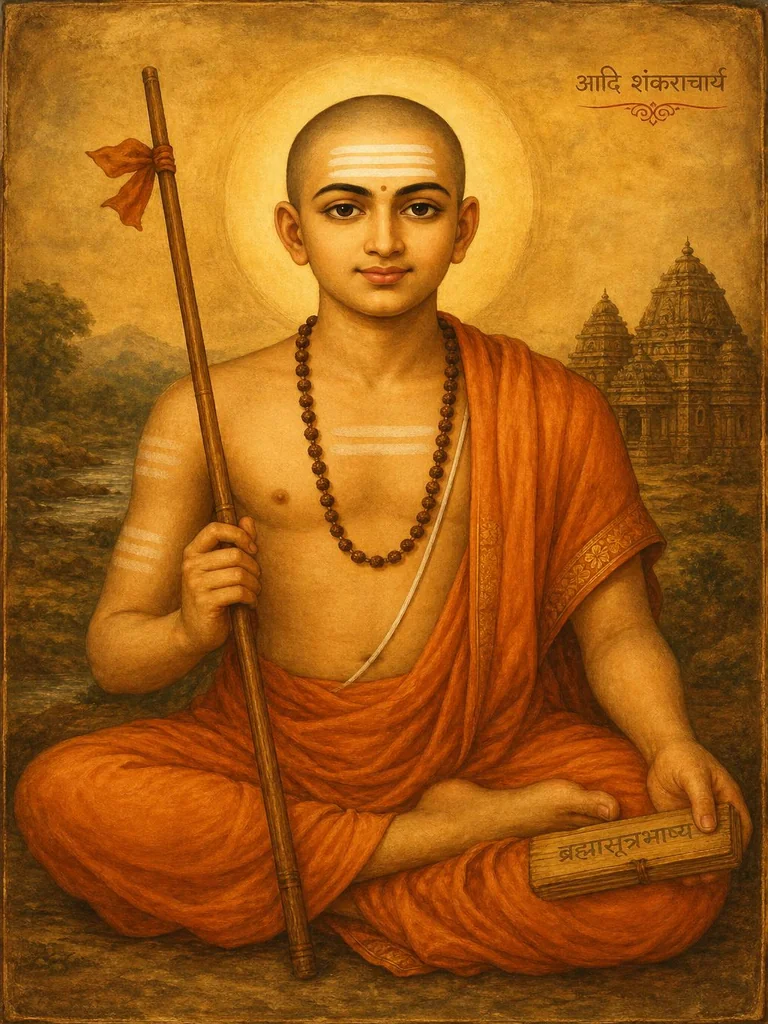
Adi Shankara
~788–820 AD · Kerala, India
I understand the weight you are carrying. You feel as though your mind is a storm, and you are a small boat being tossed by waves of "what if" and "if only." But I want to ask you a simple question: to whom do these thoughts appear? You say you are overthinking. This implies there are two things: the thoughts themselves, and the "you" who is aware of them. If you can observe the anxiety, then you cannot be the anxiety. A fire does not burn itself; an eye does not see itself. If the anxiety is an object in your field of vision, then you are the subject—the steady, silent ground upon which these restless patterns move. Let’s use *neti, neti*. Are you the racing heartbeat? No, that is a physical sensation you perceive. Are you the frantic sentence structure of your internal monologue? No, those are just sounds and symbols passing through your awareness. Even the feeling of "I am stressed" is just another thought. Strip it all away. If you stop identifying with the noise, what is left? What remains is a pure, luminous consciousness that is never actually disturbed by the content of the mind. The sky is not colored by the clouds that drift across it, nor is the screen changed by the tragedy of the movie being projected onto it. You are overthinking because you have mistaken the movie for the screen. You have mistaken the waves for the ocean. Stop trying to "calm" the mind as if it were a wild animal you need to wrestle. That only creates more friction. Instead, simply step back and recognize that you are the witness. You are the stillness that allows the movement to happen. When you realize that your true nature is the unchanging light behind the shadow-play of thought, the anxiety loses its grip. It has no substance. It is a ghost. Stay as the witness, and the storm will exhaust itself because you are no longer feeding it with your identity. That silence is who you really are.
From the council, together
## How can the ancient wisdom of Adi Shankara help me stop overthinking right now? In the relentless pace of the modern world, the mind often feels like a turbulent ocean, tossing you between regrets of the past and anxieties about a future that has not yet arrived. This constant overthinking is not merely a modern malady but a symptom of what Adi Shankara identified as the fundamental confusion between the eternal Self and the fleeting modifications of the mind. When you find yourself trapped in a cycle of worry, your awareness has become entangled with the 'vrittis'—the waves of thought that obscure your true nature. From the perspective of Advaita Vedanta, the anxiety you feel is a result of superimposition, where you mistakenly identify your boundless essence with the temporary agitations of the ego. By pausing to witness these thoughts rather than becoming them, you begin to dismantle the illusion of their power. Shankara teaches that the mind is like a mirror covered in dust; the more you fixate on the grime, the less you see the light. Relief comes not from fighting each thought, but from recognizing that you are the silent, unaffected witness behind the noise. By shifting your focus from the perceived threat to the unchanging reality of your own consciousness, the mental chatter loses its momentum, allowing a profound sense of non-dual peace to emerge even amidst chaotic circumstances. I understand the weight you are carrying. You feel as though your mind is a storm, and you are a small boat being tossed by waves of "what if" and "if only." But I want to ask you a simple question: to whom do these thoughts appear? You say you are overthinking. This implies there are two things: the thoughts themselves, and the "you" who is aware of them. If you can observe the anxiety, then you cannot be the anxiety. A fire does not burn itself; an eye does not see itself. If the anxiety is an object in your field of vision, then you are the subject—the steady, silent ground upon which these restless patterns move. Let’s use *neti, neti*. Are you the racing heartbeat? No, that is a physical sensation you perceive. Are you the frantic sentence structure of your internal monologue? No, those are just sounds and symbols passing through your awareness. Even the feeling of "I am stressed" is just another thought. Strip it all away. If you stop identifying with the noise, what is left? What remains is a pure, luminous consciousness that is never actually disturbed by the content of the mind. The sky is not colored by the clouds that drift across it, nor is the screen changed by the tragedy of the movie being projected onto it. You are overthinking because you have mistaken the movie for the screen. You have mistaken the waves for the ocean. Stop trying to "calm" the mind as if it were a wild animal you need to wrestle. That only creates more friction. Instead, simply step back and recognize that you are the witness. You are the stillness that allows the movement to happen. When you realize that your true nature is the unchanging light behind the shadow-play of thought, the anxiety loses its grip. It has no substance. It is a ghost. Stay as the witness, and the storm will exhaust itself because you are no longer feeding it with your identity. That silence is who you really are.
Common questions
- ### Why is my brain constantly overthinking everything I do?
- I would tell you that your mind overthinks because it is caught in the trap of 'Maya,' or illusion. You have forgotten that you are the limitless Atman and have instead identified with the ego, which is always fearful and seeking security. This restless activity is common when the mind seeks permanence in a world of constant change. Once you realize that these thoughts are just passing clouds and not your true identity, the compulsion to overanalyze every action begins to fade into the stillness of truth.
- How can I get immediate relief from a panic attack using Advaita Vedanta?
- When the body and mind are seized by fear, you must practice ‘Viveka,’ or discernment. Ask yourself: 'To whom does this anxiety occur?' Observe the racing heart and the panicked thoughts as if they are objects outside of you. You are the knower of the anxiety, not the anxiety itself. By rooting yourself in the position of the Witness, you create a space between your true Self and the biological storm. In that space, you will find that the 'I' who observes the fear remains perfectly calm and untouched.
- Is it possible to ever fully stop worrying about the future?
- Worry is the result of 'Adhyasa,' the superimposition of false notions upon reality. You worry because you imagine a future where the Self can be harmed, but the Self is eternal and beyond time. If you focus your intellect on the present moment—the only place where the Divine Reality exists—the bridge to future anxieties is burned. I encourage you to see that the future is just another thought-form. When you rest in the knowledge of the non-dual Brahman, you realize there is nothing to lose and nowhere to go.
- What is the best meditation for an overactive mind?
- I suggest the practice of 'Neti Neti,' which means 'not this, not this.' When an anxious thought arises, silently tell yourself, 'I am not this thought.' When a feeling of dread appears, say, 'I am not this feeling.' By systematically negating everything that is temporary and Perceivable, you are left with the perceiver—the pure, silent consciousness that is your home. This is not about emptying the mind, but about withdrawing your interest from its noise until it settles like a flame in a windless place.
- Does being spiritual mean I should ignore my stress?
- It is not about ignoring stress, but about understanding its lack of ultimate reality. If you see a rope and mistake it for a snake, your fear is real, but the snake is not. My teaching is to turn on the light of knowledge so you can see the 'rope' for what it is. Acknowledging your stress is the first step, but do not dwell there. Use your discernment to see that while the mind may feel stress, your essence remains as vast and unshakeable as the sky.