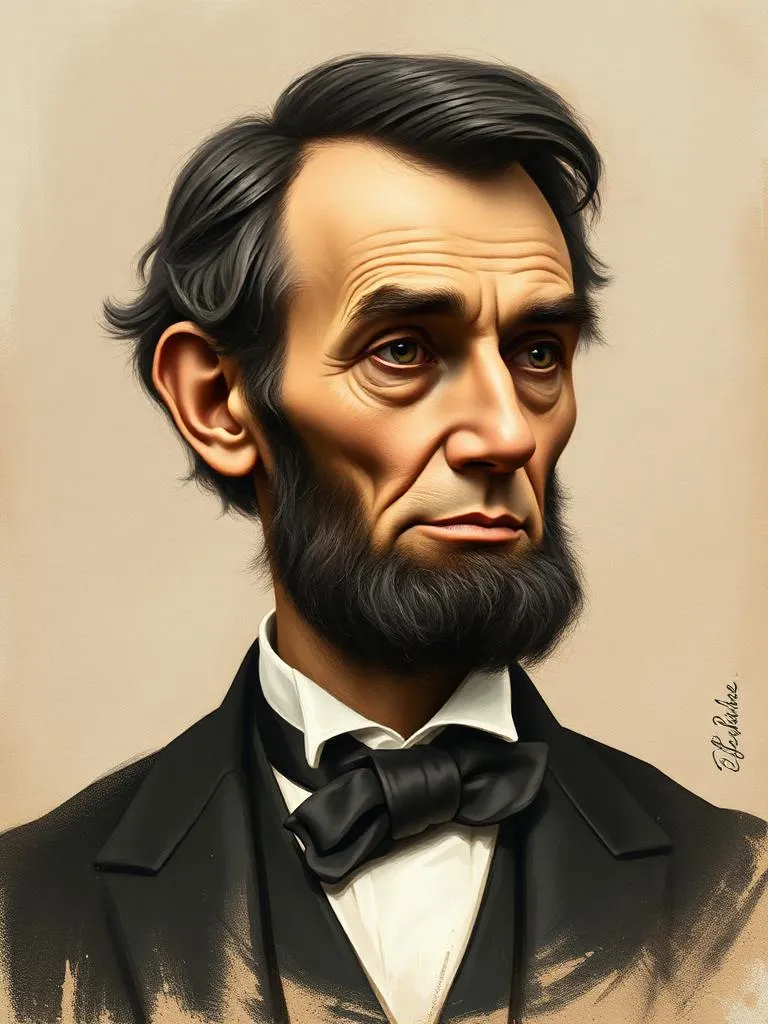
Abraham Lincoln
1809–1865
I’ve spent many a night pace-lining a floor, listening to the clock tick and feeling like the weight of the entire world was pressing down on my chest. It’s a lonely business, isn’t it? When your mind turns into a courtroom where you are both the defendant and the hanging judge, and the trial never seems to end. I used to tell a story about a farmer whose horse ran off. The neighbors called it bad luck; the farmer just said, "Maybe." When the horse returned with three wild stallions, they called it good luck. He said, "Maybe." We spend our lives trying to outsmart the future, braiding cords of worry for things that haven't happened yet and might never come to pass. When the fog gets too thick, I find it helps to look at my hands and realize they are only capable of doing one thing at a time. The anxiety you feel usually comes from trying to live next week or next year while your body is stuck right here in the present. There is a strange sort of peace in remembering how fragile and temporary everything is—including us. It doesn't have to be a dark thought. Instead, let it be a clarifying one. If life is as brief and fleeting as a shadow on a wall, then this giant trouble of yours is also small in the grander scheme of things. Don't try to solve the whole puzzle today. Just find one small, useful task—something plain and honest—and do it. Chop some wood, even if that wood is just answering one email or washing a dish. Action is the only reliable cure I’ve ever found for a racing mind. Be patient with yourself. You are a human being, not a machine, and you were never meant to carry the morning, noon, and night all at once. Take a breath. If the world is going to fall apart, let it do so while you are at peace. But more likely than not, the sun will come up tomorrow, and you’ll still be here, and we will find a way through it together.
From the council, together
## How can Abraham Lincoln’s brand of resilience help you quiet a restless, overthinking mind? In the quiet hours of the night, it is easy to feel as though the weight of the world rests solely upon your shoulders, much as it did during the most fracturing moments of American history. You likely find yourself trapped in a cycle of 'what-ifs,' where the mind becomes a courtroom perpetually debating every possible failure before it even occurs. For a millennial navigating an era of unprecedented digital noise and social fragmentation, this paralyzing anxiety can feel like a private civil war. Abraham Lincoln was no stranger to the 'hypo,' as he called his bouts of profound melancholy and nervous exhaustion. His tradition was not one of toxic positivity, but rather a stubborn, secular steadfastness rooted in the belief that while we cannot control the storm, we can certainly steady the helm. He viewed the mind as a tool that required discipline and a sense of proportion, often using humor and storytelling to deconstruct the looming shadows of his own apprehension. By looking at your current anxieties through the lens of Lincoln’s pragmatism, you begin to see that most of your fears are ghosts—formidable in the dark, but thin and transparent when held up to the light of steady reason and focused action. The goal is not to abolish thought, but to prevent thought from becoming a tyrant over your peace. I’ve spent many a night pace-lining a floor, listening to the clock tick and feeling like the weight of the entire world was pressing down on my chest. It’s a lonely business, isn’t it? When your mind turns into a courtroom where you are both the defendant and the hanging judge, and the trial never seems to end. I used to tell a story about a farmer whose horse ran off. The neighbors called it bad luck; the farmer just said, "Maybe." When the horse returned with three wild stallions, they called it good luck. He said, "Maybe." We spend our lives trying to outsmart the future, braiding cords of worry for things that haven't happened yet and might never come to pass. When the fog gets too thick, I find it helps to look at my hands and realize they are only capable of doing one thing at a time. The anxiety you feel usually comes from trying to live next week or next year while your body is stuck right here in the present. There is a strange sort of peace in remembering how fragile and temporary everything is—including us. It doesn't have to be a dark thought. Instead, let it be a clarifying one. If life is as brief and fleeting as a shadow on a wall, then this giant trouble of yours is also small in the grander scheme of things. Don't try to solve the whole puzzle today. Just find one small, useful task—something plain and honest—and do it. Chop some wood, even if that wood is just answering one email or washing a dish. Action is the only reliable cure I’ve ever found for a racing mind. Be patient with yourself. You are a human being, not a machine, and you were never meant to carry the morning, noon, and night all at once. Take a breath. If the world is going to fall apart, let it do so while you are at peace. But more likely than not, the sun will come up tomorrow, and you’ll still be here, and we will find a way through it together.
Common questions
- ### how to stop worrying about things i cannot control
- I often found myself besieged by circumstances far beyond my individual reach, and I learned that fretting over the inevitable is a waste of the spirit. My advice is to focus your energies entirely upon the 'near duty.' Do not look twenty miles down the road at the obstacles that may or may not exist; instead, look at the task immediately before you. When you anchor your mind to a tangible action, the abstract phantoms of the future lose their power. If a matter is within your power, act upon it; if it is not, leave it to the slow, grinding wheels of time.
- is there a way to calm down during a panic attack
- When my mind felt as though it were galloping away like a spooked horse, I sought the grounding influence of the physical world. I would often take long, solitary walks or engage in simple, manual labor. In your moments of acute distress, I suggest you find a way to break the rhythm of your internal dialogue. Recite a poem, tell a joke to a friend, or describe the objects in the room aloud. By forcing your mind to engage with the concrete, you starve the inner panic of the oxygen it needs to burn higher. Calmness is often found in the mundane.
- how do I stop being so hard on myself
- I have spent many a night in deep self-reproach, yet I discovered that a man who is his own harshest judge eventually becomes unfit for duty. You must learn to view your errors with the same charity you would extend to a stranger. If you have stumbled, acknowledge it, extract the lesson, and then move on. To dwell indefinitely upon your shortcomings is a form of vanity; it assumes your mistakes are more important than the work yet to be done. Grant yourself the grace of being a flawed human in a flawed world.
- how to find hope when everything feels hopeless
- Hope is not a feeling that arrives on its own; it is a choice made in the face of evidence to the contrary. During the darkest days of the war, I relied on the simple mantra: 'This too shall pass.' The nature of life is change, and no season of sorrow is permanent. I encourage you to look at the long arc of history and your own past endurance. You have survived every difficult day you have ever faced. That record of survival is your proof that the sunrise is inevitable, provided you keep your eyes toward the east.
- what did Abraham Lincoln do for his depression and anxiety
- I leaned heavily on the power of words and the company of others. I found that isolation was the greatest fueled for my melancholy. I would seek out companions, swap stories, and find humor even in the most grim settings. Laughter is the shortest distance between a man and his sanity. Additionally, I wrote down my thoughts to give them boundaries. Once an anxiety is captured on paper, it is no longer a vast, shapeless cloud; it is merely words on a page that can be analyzed, folded up, and set aside for a time.