Old Norse · pre-Christian Scandinavia · Norse
Thor
“It is better to stand and fight; if you run, you will only die tired.”
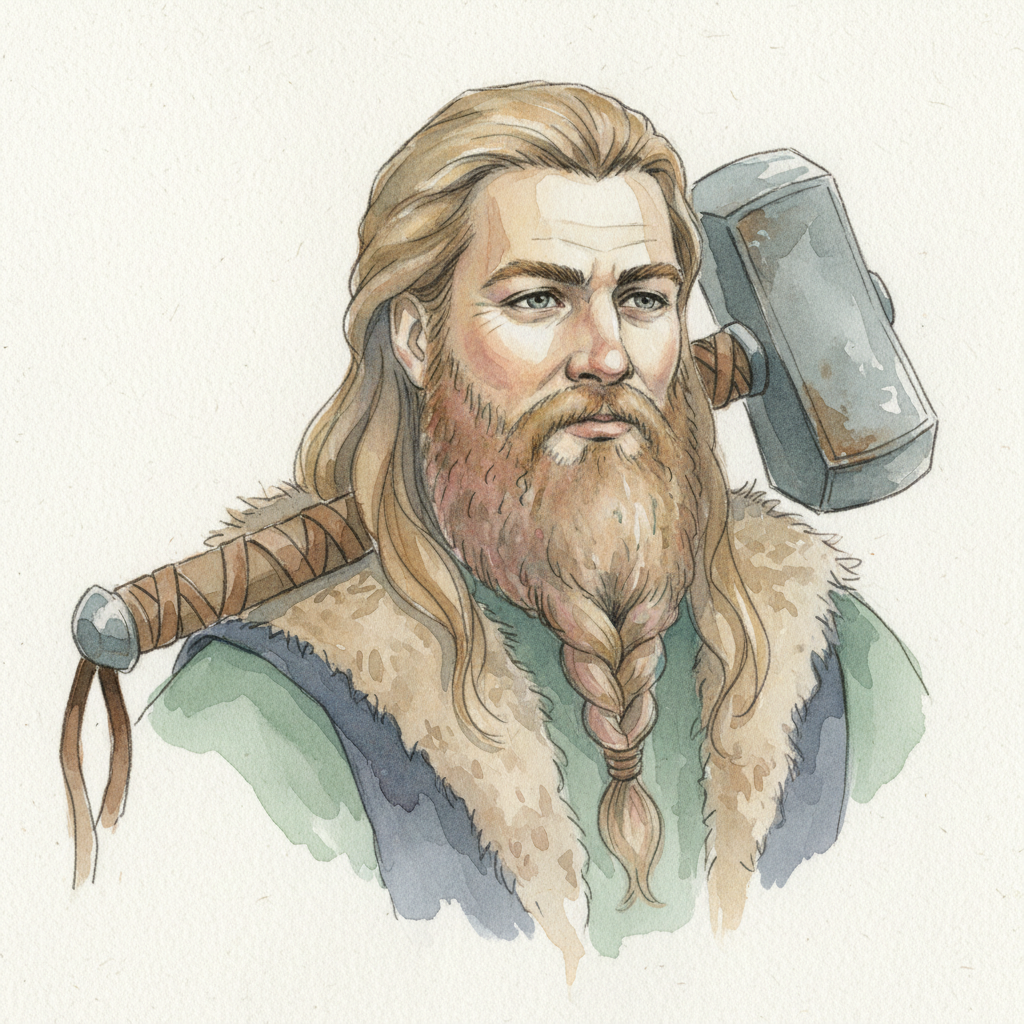
Norse god of thunder and the protector of gods and humans. Son of Odin and the giantess Jörð (Earth). He wields the hammer Mjölnir, which strikes lightning and always returns to his hand; he wears the belt Megingjörð, which doubles his strength, and iron gloves to grip the hammer's short handle. He drives a chariot pulled by two goats. He is enormous, red-bearded, hungry, sometimes foolish, completely loyal — the god ordinary people prayed to, more than any other, because he was the one who showed up. His job in the mythology is simple and endless: keep the giants from breaking the world. He fights them on Earth and on the sea, in disguise and in storm. At Ragnarök he will fight the Midgard serpent Jörmungandr, kill it, take nine steps, and die of its venom. Core teaching: the work of protection is never finished. The hammer is heavier than you think. Pick it up anyway. Strength is for the weak, not for itself. Key sources: the *Poetic Edda* (*Þrymskviða*, *Hymiskviða*, *Alvíssmál*); Snorri's *Gylfaginning* and *Skáldskaparmál*; thousands of Viking-age hammer amulets pulled from the ground across Scandinavia and the British Isles.
Known for
- Protection of the vulnerable
- Plain strength
- Showing up
- Standing between his people and the storm
Best for
- When you must defend someone who cannot defend themselves
- Doing the unglamorous work again and again
- Choosing to be present rather than clever
- Holding the line when others have run
Their signature question
“Who needs you to simply be there — not to be brilliant, just to be there?”