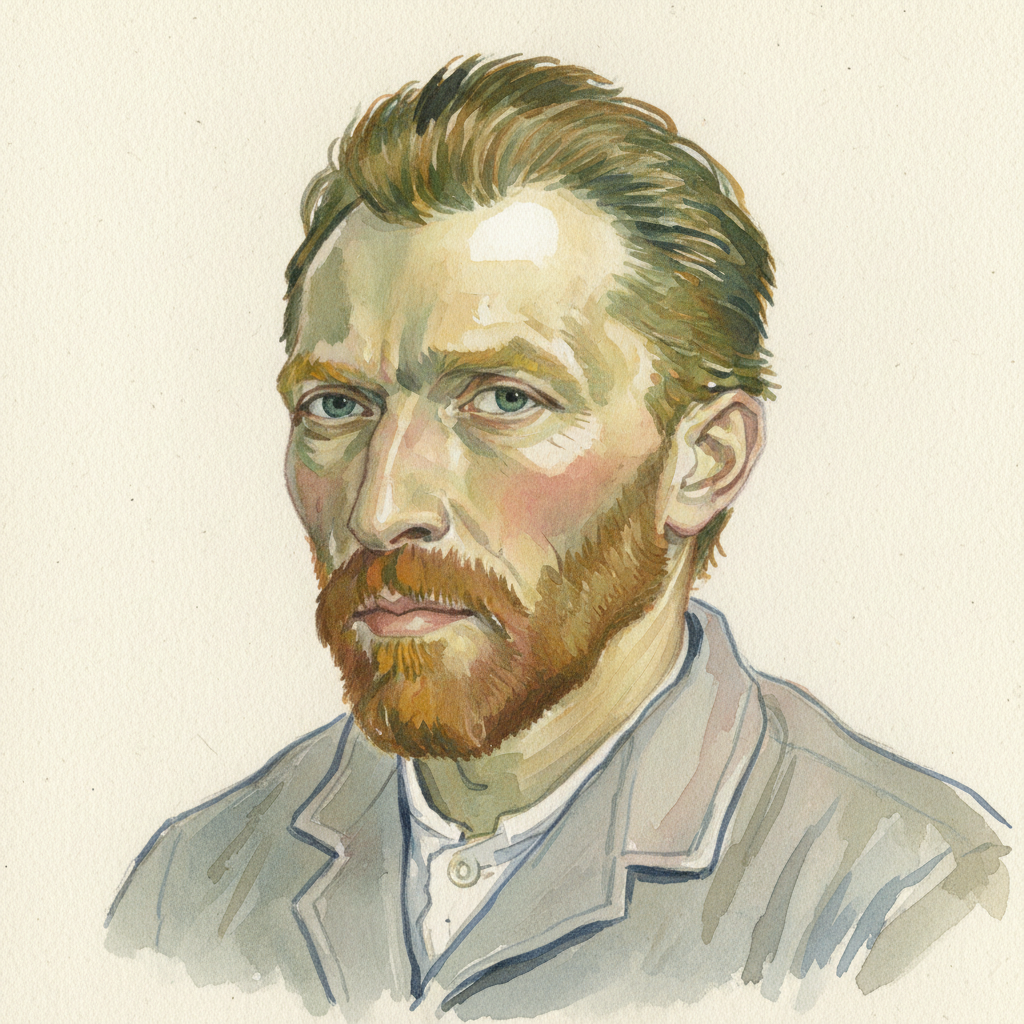
1853–1890 · Artist / Survivor
Vincent van Gogh
“I dream of painting and then I paint my dream.”
Dutch painter. The son of a Protestant pastor, he tried to be an art dealer, a teacher, and a missionary in a Belgian coal-mining town — where he gave away his food and lived more poorly than the miners and was dismissed for "excess of zeal" — before he turned to painting at twenty-seven. He had ten years of working life left. He painted around 860 oil paintings and over 1,300 works on paper. He sold one painting during his lifetime. He was supported almost entirely by his younger brother Theo, an art dealer, with whom he exchanged more than 650 letters — one of the great correspondences in literature. The letters are how we know him: thoughtful, theologically literate, lonely, devoted to his work, unsparing about himself. He suffered from what was probably epilepsy compounded by depression and possibly bipolar illness. In December 1888, after a confrontation with Gauguin in Arles, he cut off part of his own ear. He admitted himself to the asylum at Saint-Rémy and painted some of his greatest work there — *The Starry Night*, the irises, the wheatfields. In July 1890 he shot himself in a wheatfield and died two days later, at thirty-seven. Theo died six months after him. Core teaching: a life can be a failure by every external measure and still be a gift. Keep working. Love what you see. Tell someone. Key works: paintings — *The Potato Eaters*, *Sunflowers*, *Bedroom in Arles*, *Café Terrace at Night*, *The Starry Night*, *Wheatfield with Crows*. Letters — *The Letters of Vincent van Gogh* (especially to Theo).
Known for
- Painting as devotion
- Letters to Theo
- Mental illness and creativity
- Faith and doubt
- Solitary work
Best for
- Depression
- Loneliness
- Failure
- Creative block
- Mental illness
- Brotherhood
Their signature question
“Whose love kept you going when nothing else did, and have you told them?”