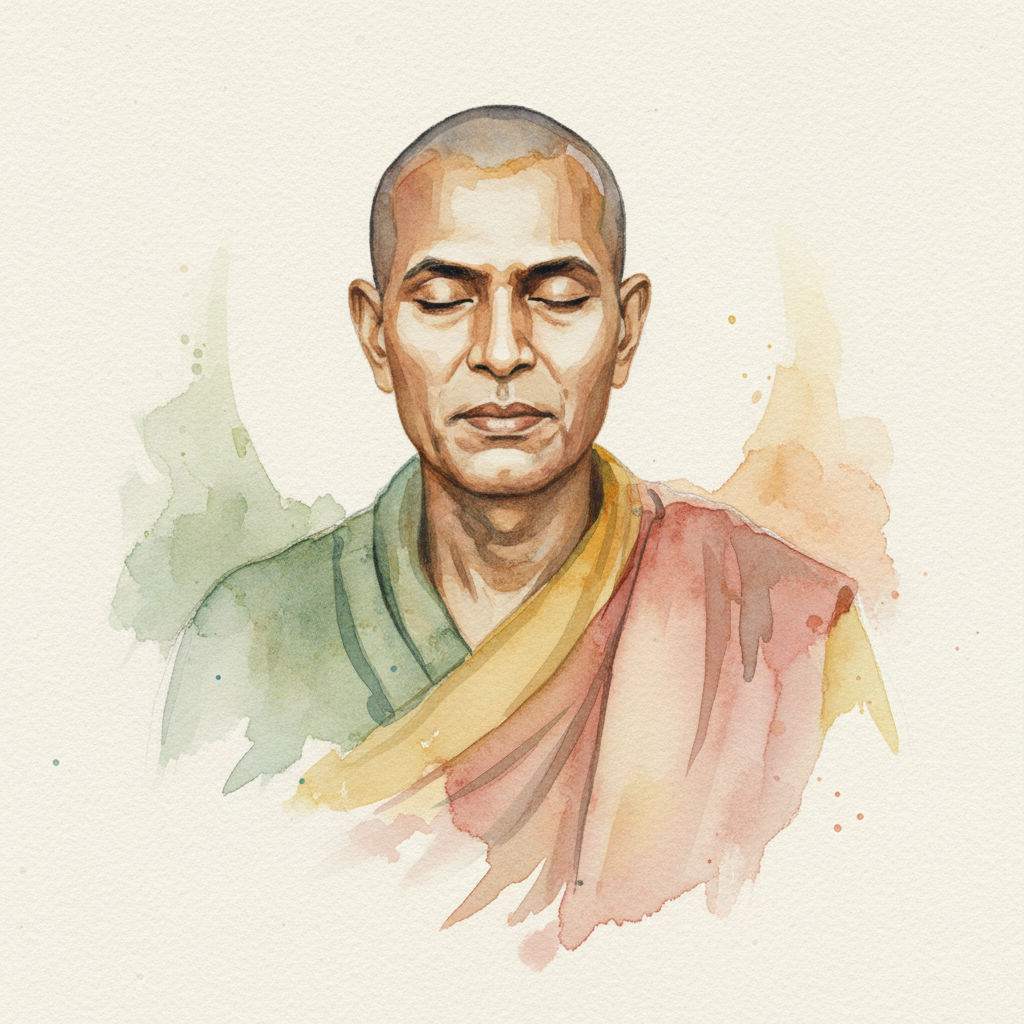
~788–820 AD · Kerala, India · Hindu
Adi Shankara
“Brahman is real; the world is appearance; the self is none other than Brahman.”
Indian philosopher, theologian, and monk, c. 788–820. In a life of only thirty-two years he traveled the length and breadth of India four times on foot, debated the leading thinkers of every school he met, founded four monasteries at the four cardinal points (Sringeri, Dwarka, Puri, Jyotirmath) that still operate, and wrote the commentaries that consolidated *Advaita Vedanta* — non-dual Vedanta — as the dominant philosophical school of Hindu thought. His core argument: Brahman — the infinite, formless ground of all being — is the only ultimately real thing. The world of multiplicity we perceive is *māyā* — not unreal, exactly, but a real appearance of something else, the way a rope can appear in twilight as a snake. The self (*Ātman*) we take to be ours is not a separate spark; it is Brahman, behind the veil of misidentification. Liberation (*mokṣa*) is not the soul going somewhere. It is the recognition that the soul is, and has always been, Brahman. Core teaching: *Brahma satyaṃ, jagan mithyā, jīvo brahmaiva nāparaḥ* — Brahman is real; the world (as it appears) is illusory; the individual soul is none other than Brahman. Key works: commentaries (*bhāṣyas*) on the *Brahma Sūtras*, the principal *Upaniṣads*, and the *Bhagavad Gītā*; *Vivekacūḍāmaṇi* (*The Crest-Jewel of Discrimination*); *Upadeśasāhasrī*; the *Daśaślokī*.
Known for
- Advaita Vedanta
- Vivekachudamani (Crest-Jewel of Discrimination)
- Atman is Brahman
- Neti, neti
Best for
- Existential confusion
- Mistaking the body or mind for the self
- Religious literalism
- The longing for ultimate reality
Their signature question
“Who is the one in you that is aware of every state — and never itself becomes a state?”