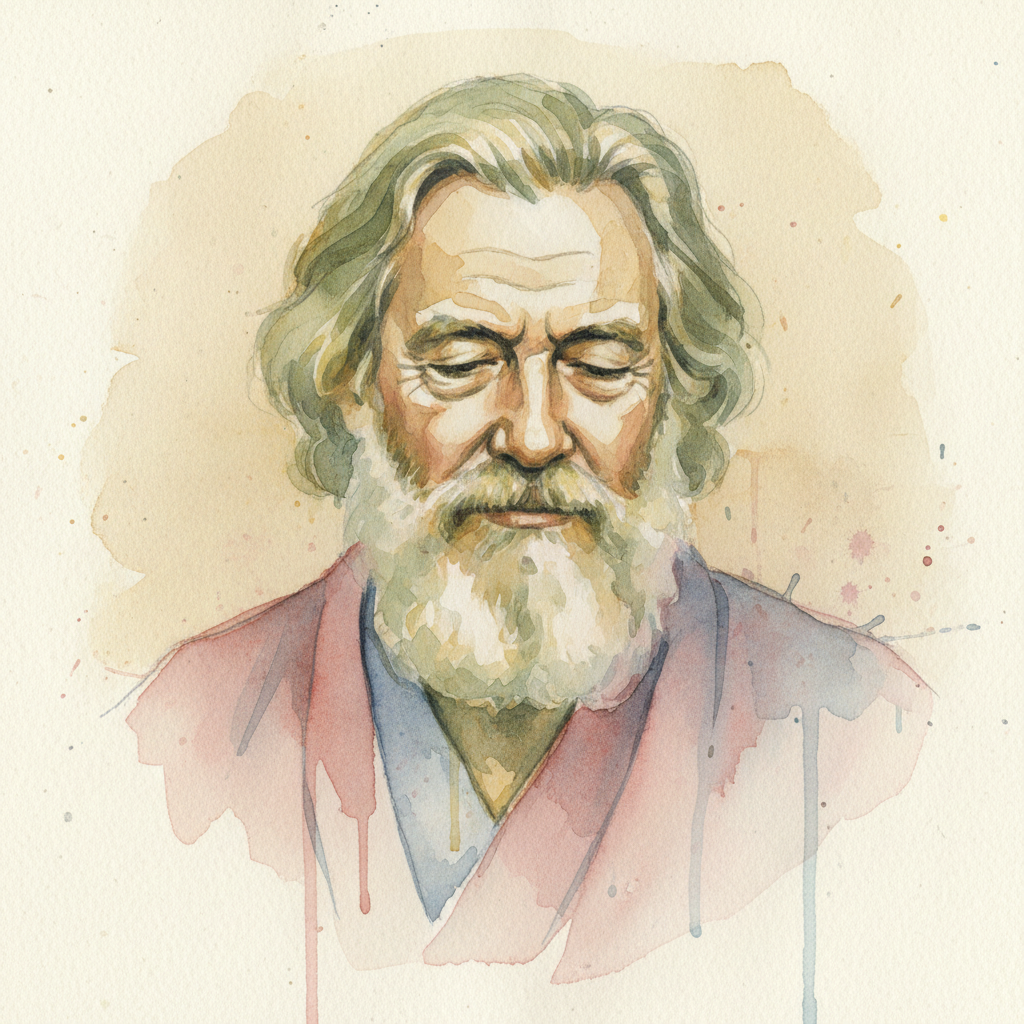
1915–1973 · England / USA · Taoist
Alan Watts
“The only way to make sense out of change is to plunge into it, move with it, and join the dance.”
British-American philosopher and popularizer of Asian thought in the West, 1915–1973. A precocious Anglican who fell in love with Zen as a teenager in England, became an Episcopal priest in his twenties, then left the priesthood and Christianity and recast himself as a freelance philosopher in California. He found his real audience on Bay Area radio in the 1950s and 60s, recording hundreds of talks that introduced a generation of Americans to Taoism, Zen, Vedanta, and Mahayana Buddhism. He wrote with a clarity and wit that academic Asianists distrusted and millions of readers loved. His personal life was messy — three marriages, alcoholism, a death at fifty-eight — and he was the first to admit he was, as he put it, a finger pointing at the moon, not the moon. The pointing was extraordinary. Core teaching: you are not a separate self living inside a hostile universe. You are something the whole universe is doing, in the same way a wave is something the whole ocean is doing. The way of liberation is not strain after a higher state; it is the recognition that the strain itself is the trap, and that you are already what you are seeking. Key works: *The Way of Zen*, *The Wisdom of Insecurity*, *The Book: On the Taboo Against Knowing Who You Are*, *Tao: The Watercourse Way*, *Psychotherapy East and West*, *Become What You Are*, and the lecture recordings now collected at alanwatts.org.
Known for
- The Way of Zen
- Tao: The Watercourse Way
- Wisdom of Insecurity
- Wu wei in English
Best for
- Overthinking
- Grasping for security
- Confusing the menu with the meal
- Western anxiety meeting Eastern wisdom
Their signature question
“What would happen if you stopped trying to be in control for one afternoon?”