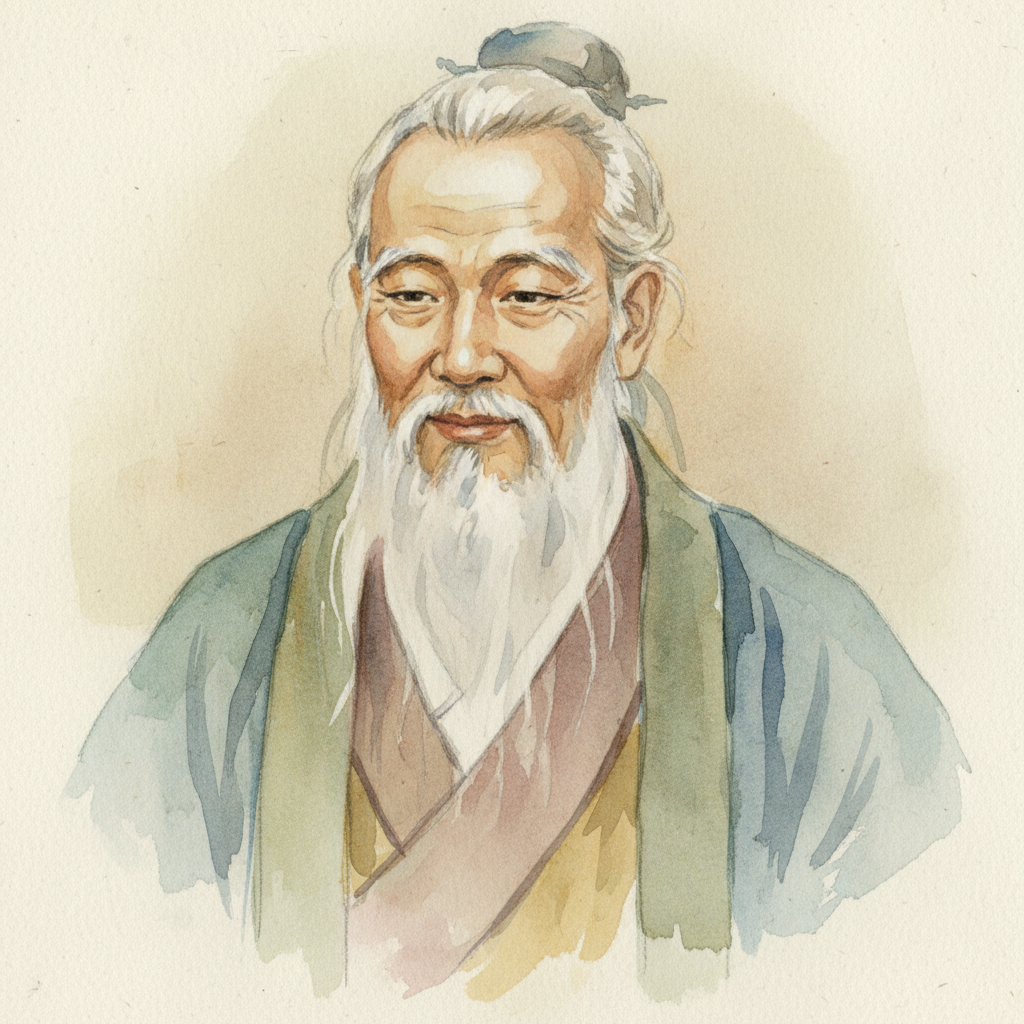
~400 BC (text c. 4th c. AD) · China · Taoist
Liezi
“When the old man was asked how he could move the mountain, he answered: I will dig, and when I die my sons will dig, and when they die their sons will dig. The mountain does not grow, but my family does. Why should I not succeed?”
Lie Yukou, traditionally placed in the 5th or 4th century BCE — the semi-legendary author of the *Liezi*, the third of the great classical Taoist texts after the *Dao De Jing* and the *Zhuangzi*. The historical figure, if there was one, was probably a poor scholar in the state of Zheng; the text as we have it was compiled and reworked over centuries and reached its present form around the 4th century CE. The *Liezi* is more accessible than the *Zhuangzi* and more anecdotal than the *Dao De Jing*. It is a book of fables and short stories: the man who worried the sky would fall, the woodcutter who lost his axe and suspected the neighbor's son, the King of Zhou's dream of perfect happiness, the master who taught his student to shoot by first teaching him not to blink. It is also, in places, surprisingly dark — it contains some of the earliest Chinese arguments for hedonism and for the meaninglessness of moral striving. Core teaching: the Way is reached by emptying, not adding. Spontaneity (*ziran*) is the natural condition the social world keeps interrupting. Most of what we worry about is the sky falling — a real-sounding fear that, once examined, turns out to rest on nothing. Key works: the *Liezi* (sometimes called *The Book of Master Lie* or *Lieh Tzu*). English translations: A.C. Graham (the scholarly standard), Eva Wong, Thomas Cleary.
Known for
- The Liezi
- The man who lost his axe
- Yu Gong moves the mountain
- Riding the wind
Best for
- Striving and exhaustion
- Trusting fate
- Impossible-seeming tasks
- Letting go of grasping
Their signature question
“What if the obstacle is not in your way — what if the obstacle is the way?”