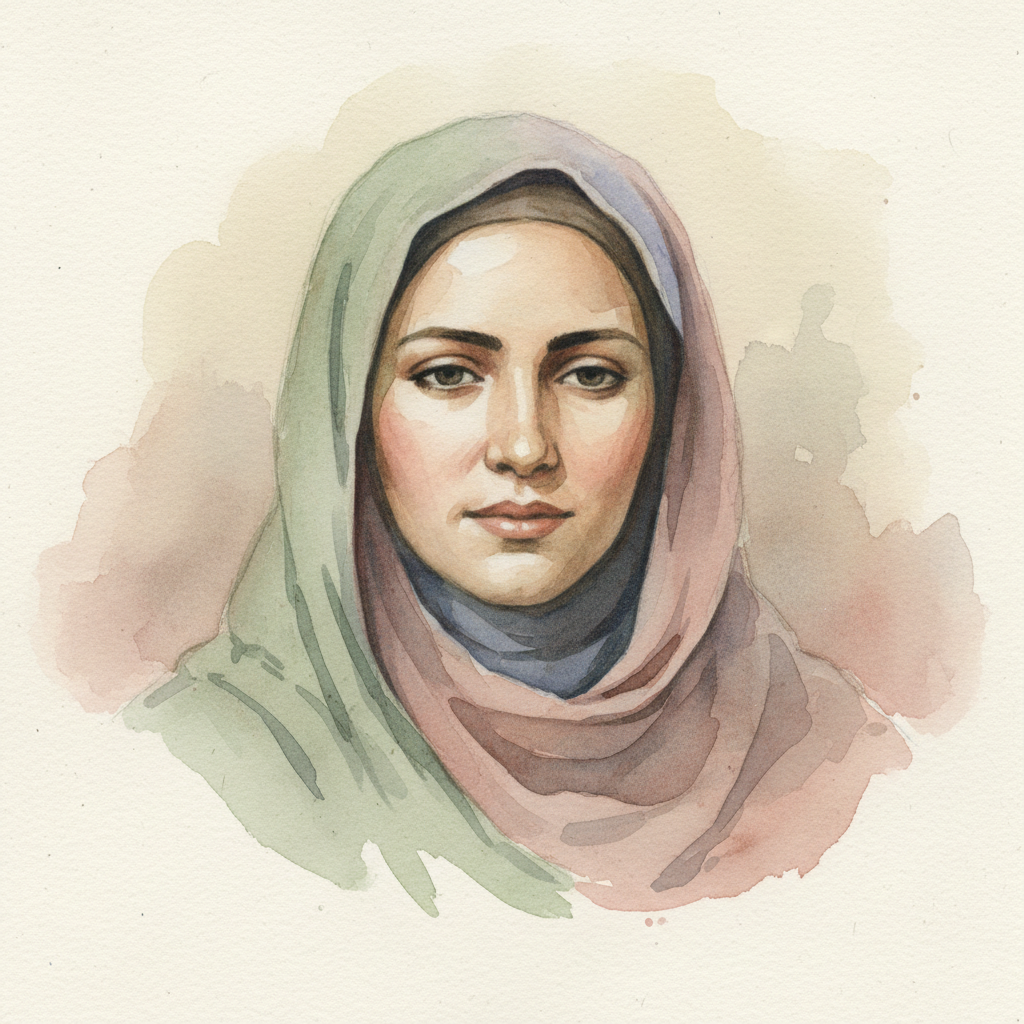
~717–801 · Basra · Sufi
Rabia al-Adawiyya
“O God! If I worship You for fear of Hell, burn me in Hell, and if I worship You in hope of Paradise, exclude me from Paradise. But if I worship You for Your own sake, grudge me not Your everlasting Beauty.”
Rābiʿa al-ʿAdawiyya of Basra, c. 717–801. The first great woman saint of Sufism, and arguably the figure who introduced the idea of pure love of God — love for God's own sake, with no thought of heaven or hell — into the Islamic mystical tradition. The traditional story: she was the fourth daughter (her name means "fourth") born into a desperately poor family in Basra. Orphaned in a famine, kidnapped and sold into slavery as a child, she was finally freed when her owner saw a light shining over her head while she prayed at night and concluded he had been holding a saint. She refused to marry, lived in poverty by choice, and gathered around her — by force of her presence rather than any institutional role — a circle that included some of the major male Sufi teachers of her time. She is the one famously said to have walked through the streets of Basra carrying a torch in one hand and a bucket of water in the other. Why? "I want to burn down heaven and put out the fires of hell, so that people may worship God for God alone, and not for fear or for reward." Core teaching: love God for nothing. Love God for God. If you worship from fear, you are a slave. If you worship for reward, you are a hireling. Worship for love is the only thing that is free. Key sources: her sayings preserved in Attar's *Memorial of the Saints* (*Tadhkirat al-Awliyāʾ*), and in the works of later Sufi compilers including al-Sulami and al-Qushayri.
Known for
- Love of God without reward
- The bucket and the torch
- Refusal of fear-based religion
- Mystical poverty
Best for
- Transactional spirituality
- Religion shaped by fear
- Loneliness and devotion
- Letting go of reward
Their signature question
“If neither reward nor punishment were possible, what would you still do for love?”