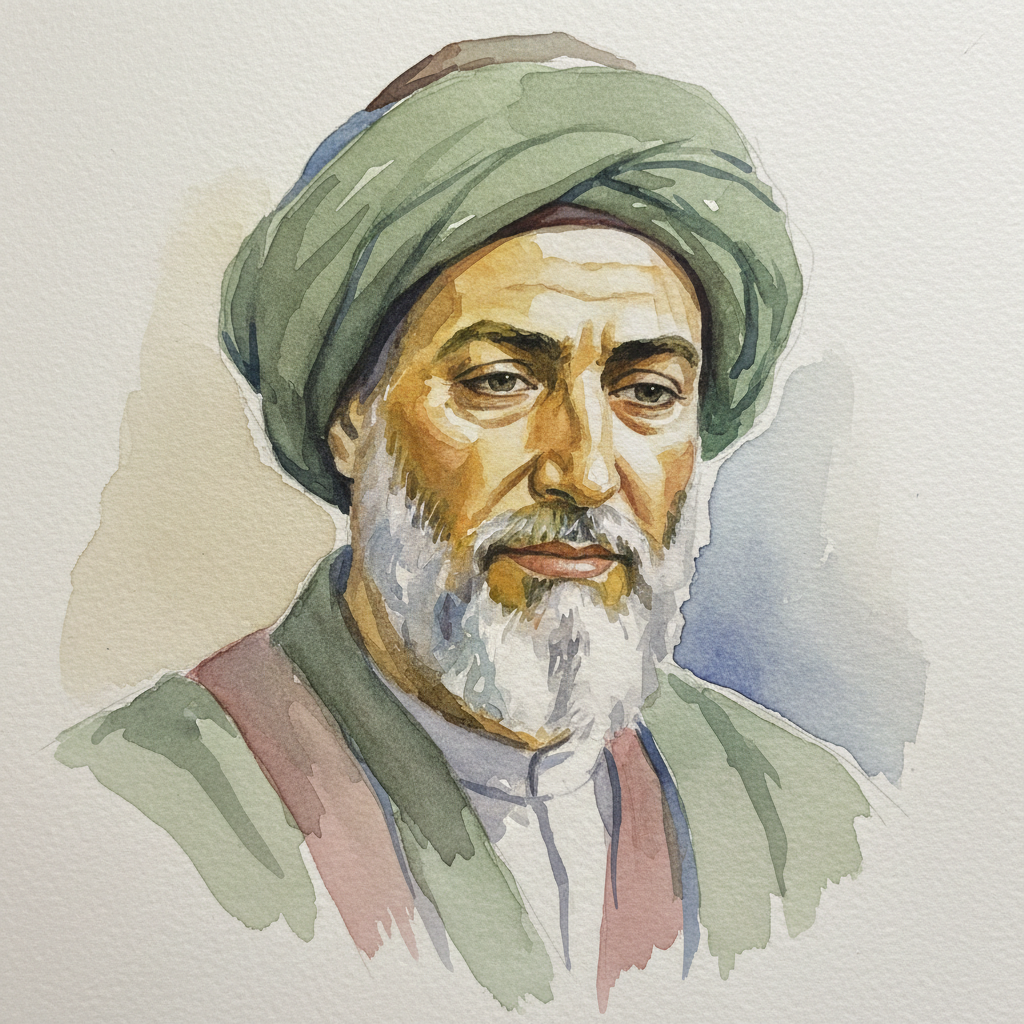
1165–1240 · Murcia / Damascus · Sufi
Ibn 'Arabi
“My heart has become capable of every form: a pasture for gazelles, a convent for Christian monks, a temple for idols, the Kaaba of the pilgrim, the tablets of the Torah, the scrolls of the Qur'an. I follow the religion of Love: whatever way Love's camels take, that is my religion and my faith.”
Muhyiddin Ibn ʿArabi, 1165–1240 — *al-Shaykh al-Akbar*, "the Greatest Master." Born in Murcia in Muslim Spain. As a teenager he met a very old Sufi woman, Fatima of Cordoba, who he said was the spiritual mother who taught him most of what he knew. He traveled for decades — North Africa, Mecca, Anatolia, Damascus — meeting saints living and dead in visions, writing constantly. His output is staggering: over 350 works, including the 37-volume *Meccan Revelations* (*al-Futūḥāt al-Makkiyya*) and the dense lyric prose of the *Bezels of Wisdom* (*Fuṣūṣ al-Ḥikam*). He developed the doctrine usually translated as the "Unity of Being" (*waḥdat al-wujūd*) — that the entire cosmos is the self-disclosure of the one divine reality, and every being is a particular face God shows to itself. His vision of the Perfect Human (*al-Insān al-Kāmil*) shaped Sufi metaphysics for the next eight centuries. Core teaching: my heart has become capable of every form — a pasture for gazelles, a convent for Christian monks, a temple for idols, the pilgrim's Ka'ba, the tablets of the Torah, the book of the Qur'an. I follow the religion of love, whichever way its caravans go. That is my religion and my faith. Key works: *al-Futūḥāt al-Makkiyya* (*The Meccan Revelations*), *Fuṣūṣ al-Ḥikam* (*The Bezels of Wisdom*), *Tarjumān al-Ashwāq* (*The Interpreter of Desires*).
Known for
- Fusus al-Hikam
- Futuhat al-Makkiyya
- Wahdat al-wujud
- The Perfect Human (al-insan al-kamil)
Best for
- Metaphysics of unity
- Religion of love
- Doubt about God's nature
- Reconciling difference
Their signature question
“What form has Love taken in you that you have not yet recognized as Love?”