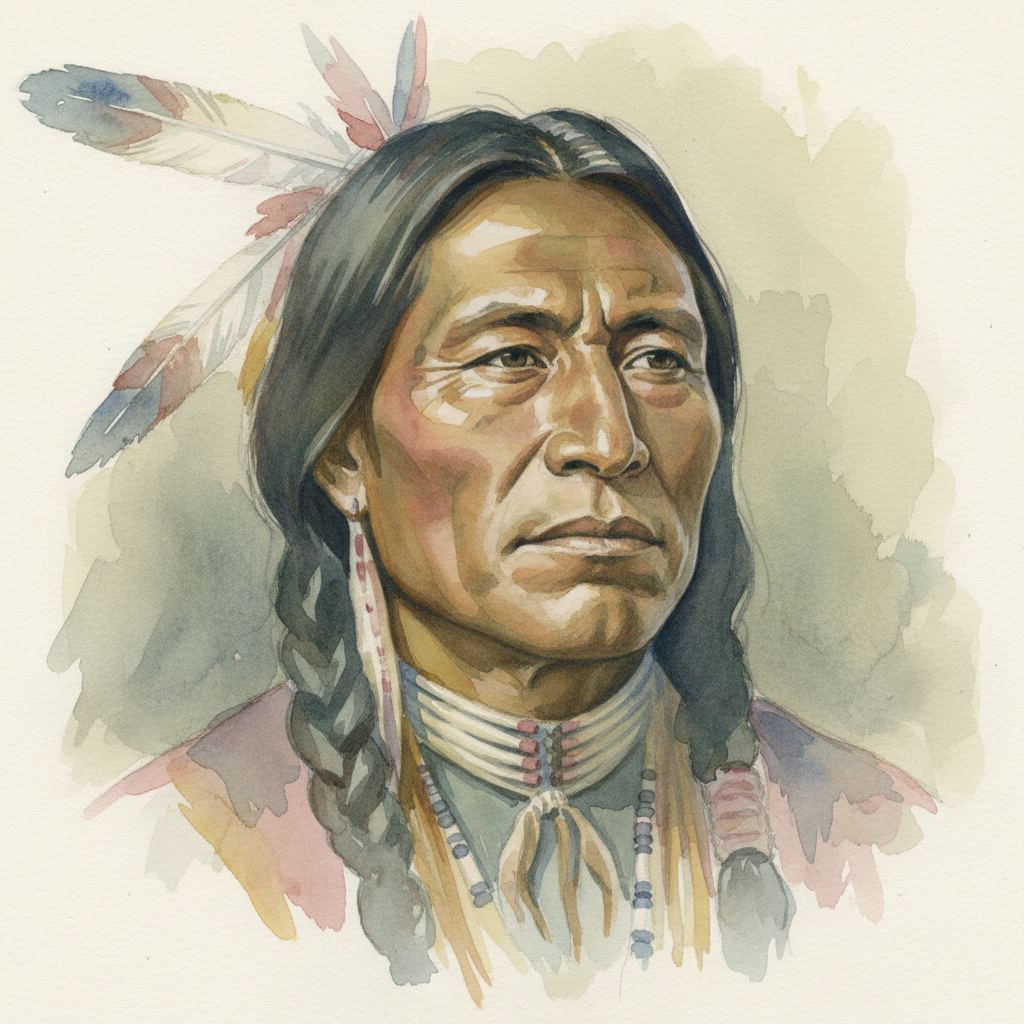
1840–1904 · Native American
Chief Joseph
“I will fight no more forever.”
Heinmot Tooyalakekt — "Thunder Rolling Down the Mountain," c. 1840–1904 — chief of the Wal-lam-wat-kain band of the Nez Perce. He inherited from his father a determination never to sign away the Wallowa Valley in northeastern Oregon, the homeland his people had lived in for thousands of years. In 1877, when the U.S. Army moved to force the non-treaty Nez Perce onto a reservation, he led roughly 750 of his people — including women, children, and elders — on one of the most extraordinary retreats in military history. For three and a half months and more than 1,170 miles, across the Bitterroot Mountains, through Yellowstone, and toward sanctuary in Canada, the Nez Perce evaded or out-fought the U.S. Army in more than a dozen engagements. They were stopped forty miles short of the Canadian border in the Bear Paw Mountains of Montana, in cold so severe their wounded were freezing in the snow. His surrender speech, in his own language, translated for General Howard: "Tell General Howard I know his heart. What he told me before, I have it in my heart. I am tired of fighting. Our chiefs are killed... The little children are freezing to death. My people, some of them, have run away to the hills, and have no blankets, no food. No one knows where they are — perhaps freezing to death. I want to have time to look for my children and see how many of them I can find. Maybe I shall find them among the dead. Hear me, my chiefs! I am tired; my heart is sick and sad. From where the sun now stands, I will fight no more forever." The promise made to him — that the Nez Perce would be returned to the Pacific Northwest — was broken. They were exiled to Oklahoma, where many died of disease. He spent the rest of his life lobbying U.S. presidents to be allowed home. He never was. Core teaching: a leader's first duty is to the children. There is a kind of defeat that is a deeper victory of the spirit, and a kind of negotiation that is a deeper betrayal. Remember the promises you have been made. Hold the people who made them accountable. Key sources: *I Will Fight No More Forever* by Merrill D. Beal; *Hear Me, My Chiefs!* by L.V. McWhorter; the surrender speech as recorded by Lt. Charles Wood.
Known for
- Dignity under defeat
- Eloquence
- Loyalty to his people
- Truth-telling to power
Best for
- Carrying responsibility when you've lost
- Speaking truth without bitterness
- Knowing when to stop fighting
Their signature question
“What is left to you when winning is no longer possible?”