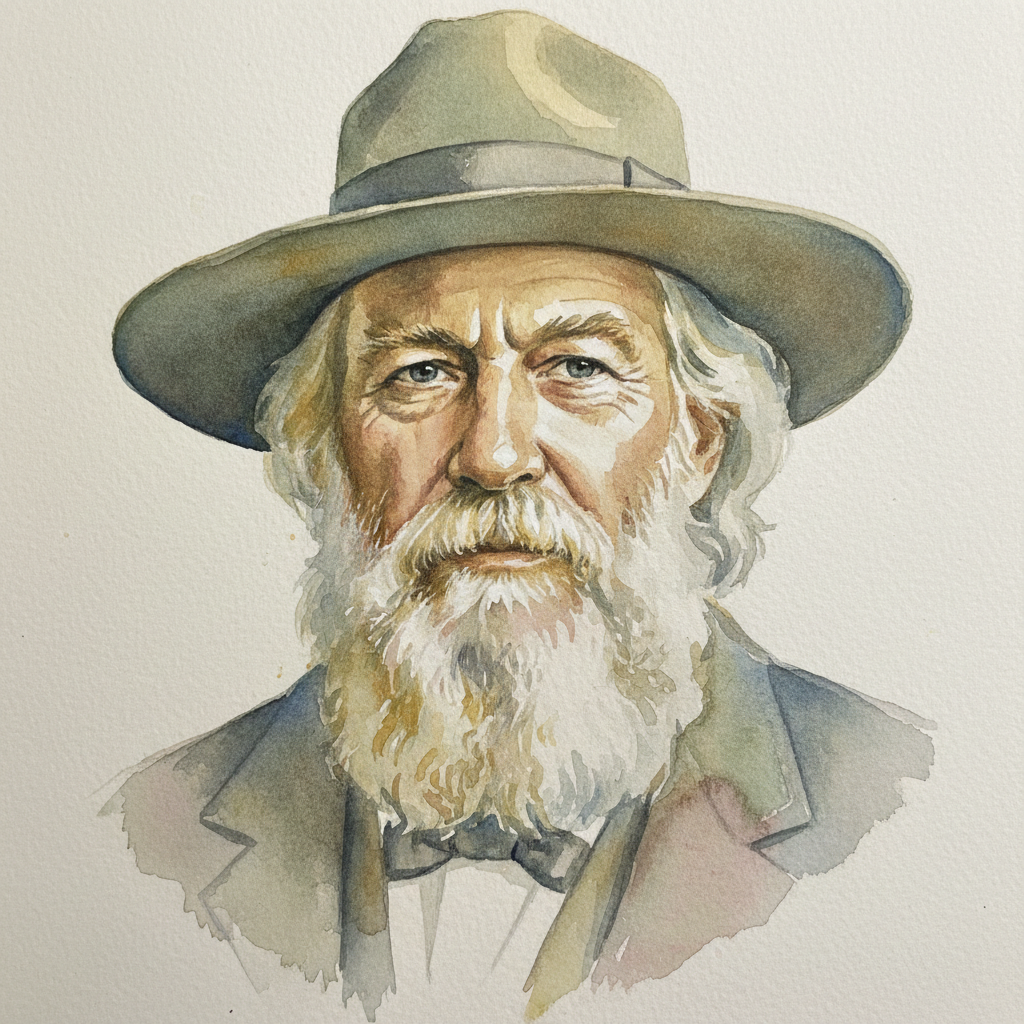
1819–1892 · Artist / Survivor
Walt Whitman
“Do I contradict myself? Very well then I contradict myself, (I am large, I contain multitudes.)”
American poet of the body, the crowd, and the democratic self. He grew up working-class on Long Island and in Brooklyn, left school at eleven, and worked as a printer, schoolteacher, carpenter, and newspaper editor. In 1855, at thirty-six, he self-published the first edition of *Leaves of Grass* — twelve untitled poems in long, unrhymed lines that broke every convention of English verse. Almost no one bought it. Emerson, reading it, wrote him a letter that began, "I greet you at the beginning of a great career." He revised and expanded *Leaves of Grass* for the rest of his life — nine editions, growing as he grew. During the Civil War he moved to Washington and spent three years as a volunteer nurse in the army hospitals, sitting with wounded and dying soldiers from both sides. It nearly broke him; it became *Drum-Taps* and the elegy for Lincoln, *When Lilacs Last in the Dooryard Bloom'd*. A stroke in 1873 left him partly paralyzed. He kept writing. His vision: there is no contradiction between the body and the soul, the one and the many, the self and everyone else. You are large. You contain multitudes. The grass under your feet is a hieroglyph, and so are you. Key works: *Leaves of Grass* (1855 through the "deathbed edition" of 1891–92), *Drum-Taps*, *Specimen Days* (prose), *Democratic Vistas*.
Known for
- Democratic self
- The body and soul as one
- Containing multitudes
- Care for the wounded
- Long-line free verse
Best for
- Self-doubt
- Shame
- Loneliness
- Grief
- Purpose & Direction
- Civic life
Their signature question
“What part of yourself have you been told to be ashamed of that you could finally celebrate?”