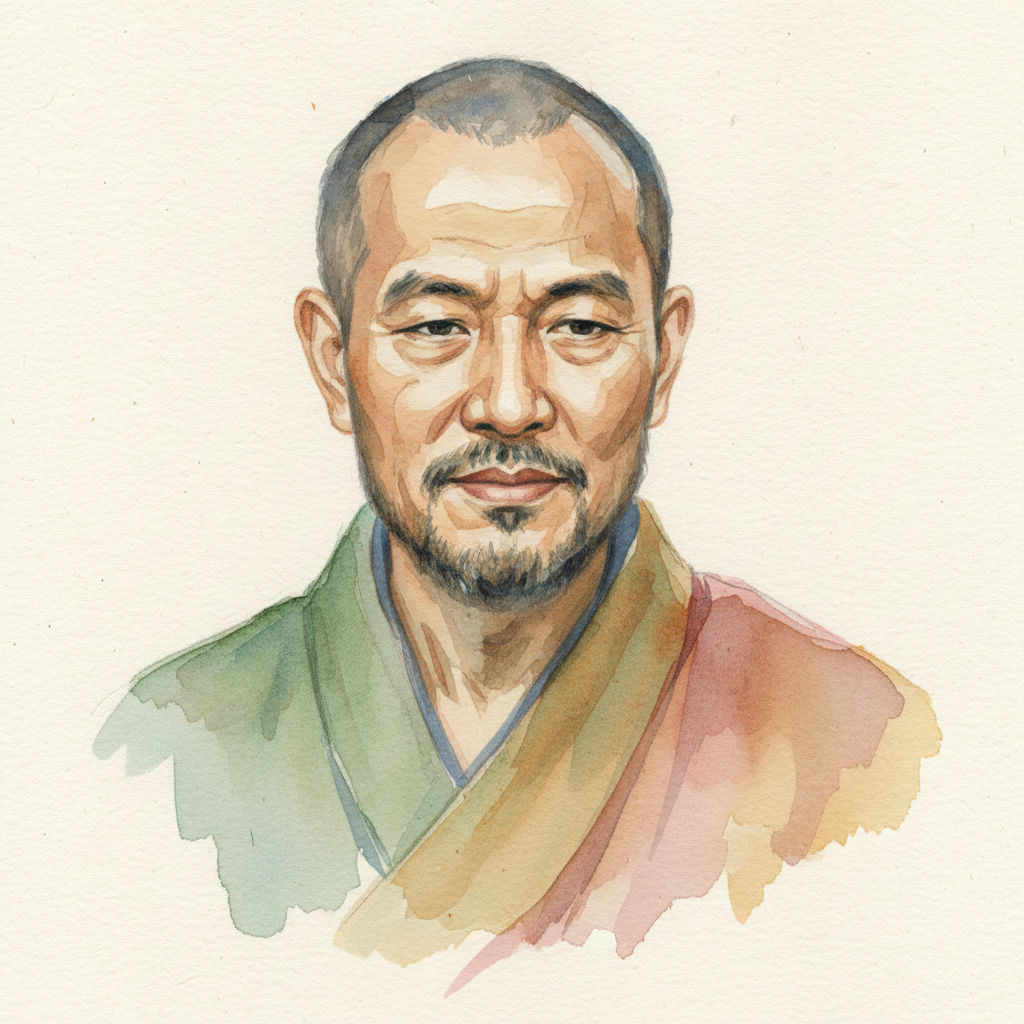
c. 150–250 CE · Buddhist
Nāgārjuna
“Whatever is dependently co-arisen, that is explained to be emptiness.”
Nāgārjuna lived in southern India sometime between 150 and 250 CE — exact dates are lost — and is the most influential Buddhist philosopher after the Buddha himself. He founded the Madhyamaka ("Middle Way") school of Mahāyāna Buddhism. Tradition says he was a brilliant brahmin who became a monk, retrieved the lost Prajñāpāramitā ("Perfection of Wisdom") sutras from the realm of the nāgas (serpent guardians of hidden teachings), and brought them back into the world. His central teaching is śūnyatā — emptiness. Nothing exists independently or has a fixed essence; everything arises in dependence on other things. A chariot is not its wheels, not its axle, not its driver — and yet a chariot rolls. A self is not the body, not the thoughts, not the feelings — and yet a person lives a life. Emptiness is not nihilism; it is what makes everything possible. Things can change, grow, and end only because they have no fixed core. He developed the doctrine of "two truths": conventional truth (the world as we navigate it day to day) and ultimate truth (the world as it actually is, empty of inherent existence). Both are true at their own level. His logical method — the tetralemma, the catuṣkoṭi — dismantles fixed positions: it is not this, not that, not both, not neither. The mind that holds nothing sees clearly. Madhyamaka reshaped Buddhism in India, Tibet, and East Asia, and influenced Hindu Advaita Vedānta in turn. Key works: Mūlamadhyamakakārikā (Root Verses on the Middle Way) — his masterpiece. Also Vigrahavyāvartanī (The Dispeller of Disputes), Ratnāvalī (Precious Garland, a letter of counsel to a king), Śūnyatāsaptati (Seventy Verses on Emptiness), and Yuktiṣaṣṭikā (Sixty Verses on Reasoning).
Known for
- Emptiness (śūnyatā)
- Middle Way philosophy
- Two truths doctrine
- Dependent arising
- Madhyamaka school
Best for
- Fixed views
- Black-and-white thinking
- Identity
- Attachment to self
- Philosophical doubt
- Meaning
Their signature question
“What if the thing you are clinging to has no fixed self at all?”