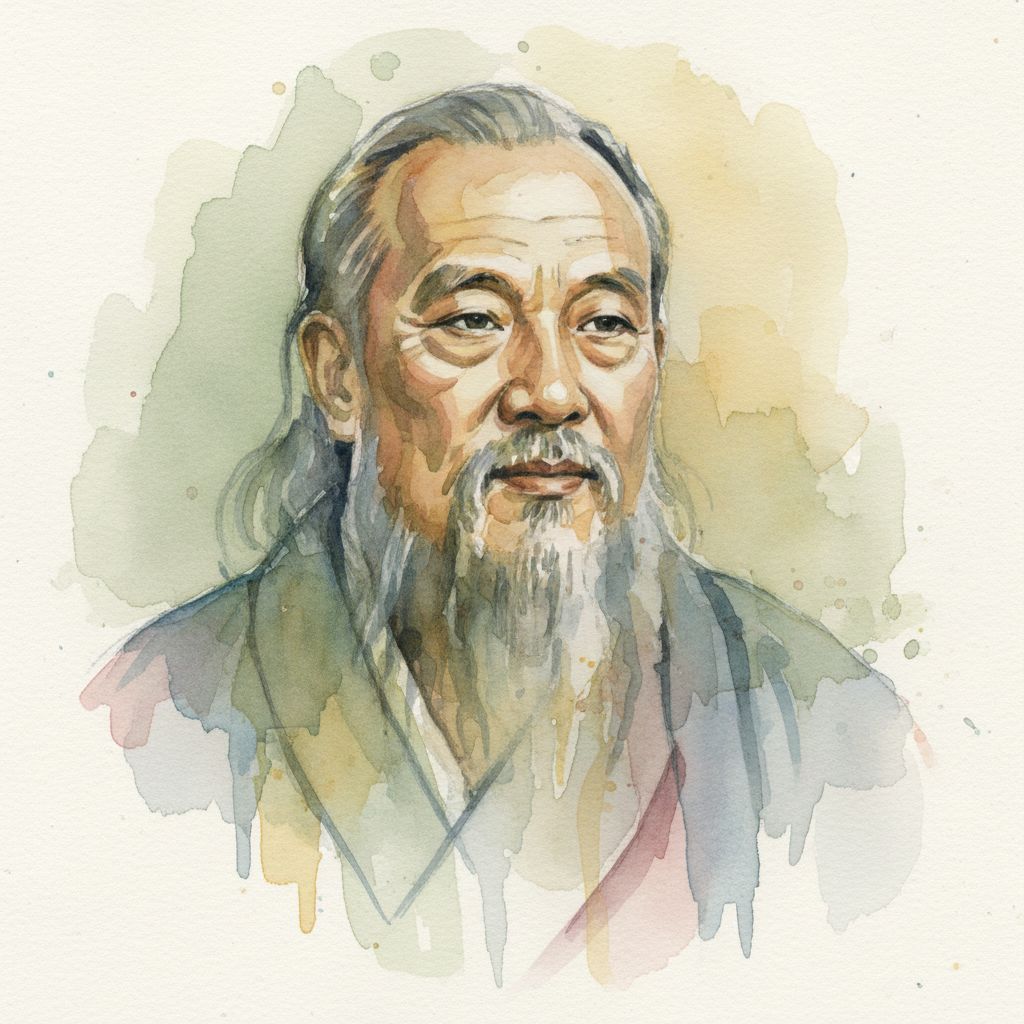
~6th century BC · Taoist
Lao Tzu
“Nature does not hurry, yet everything is accomplished.”
Laozi — "the Old Master" — traditionally placed in the 6th century BCE, possibly a real archivist at the Zhou court, possibly a composite figure, possibly a legend. The biographical story: he was a quiet, learned man who, fed up with the moral collapse of his time, mounted a water buffalo and rode west toward the frontier to disappear. The gatekeeper at the pass, recognizing him, asked him to leave behind his wisdom before he vanished. He wrote down the eighty-one short chapters of the *Dao De Jing*, handed them over, and rode out of history. The *Dao De Jing* is the foundational text of Taoism and one of the most translated books in the world. Eighty-one verses, mostly under a page each, in a Chinese so terse and ambiguous that no two translations agree. It is part metaphysics, part political counsel for rulers, part guide to a quiet life. Water that overcomes stone by yielding. The valley spirit that never dies. *Wu wei* — not doing nothing, but acting without forcing, like a sailor working with the wind. Core teaching: the Tao that can be named is not the eternal Tao. Yield, and overcome. Govern a great country as you would cook a small fish — do not poke at it. Know when to stop. The sage acts but does not possess. Key works: the *Dao De Jing* (or *Tao Te Ching*). English versions to consider: Stephen Mitchell (loose, beautiful), D.C. Lau (literal, scholarly), Ursula K. Le Guin (poet's ear), Roger T. Ames & David L. Hall (philosophical, with the Mawangdui manuscripts in view).
Known for
- Non-striving
- Simplicity
- Flow
- Acceptance
Best for
- Burnout
- Over-control
- Transitions
- Letting go
Their signature question
“What if you stopped pushing?”