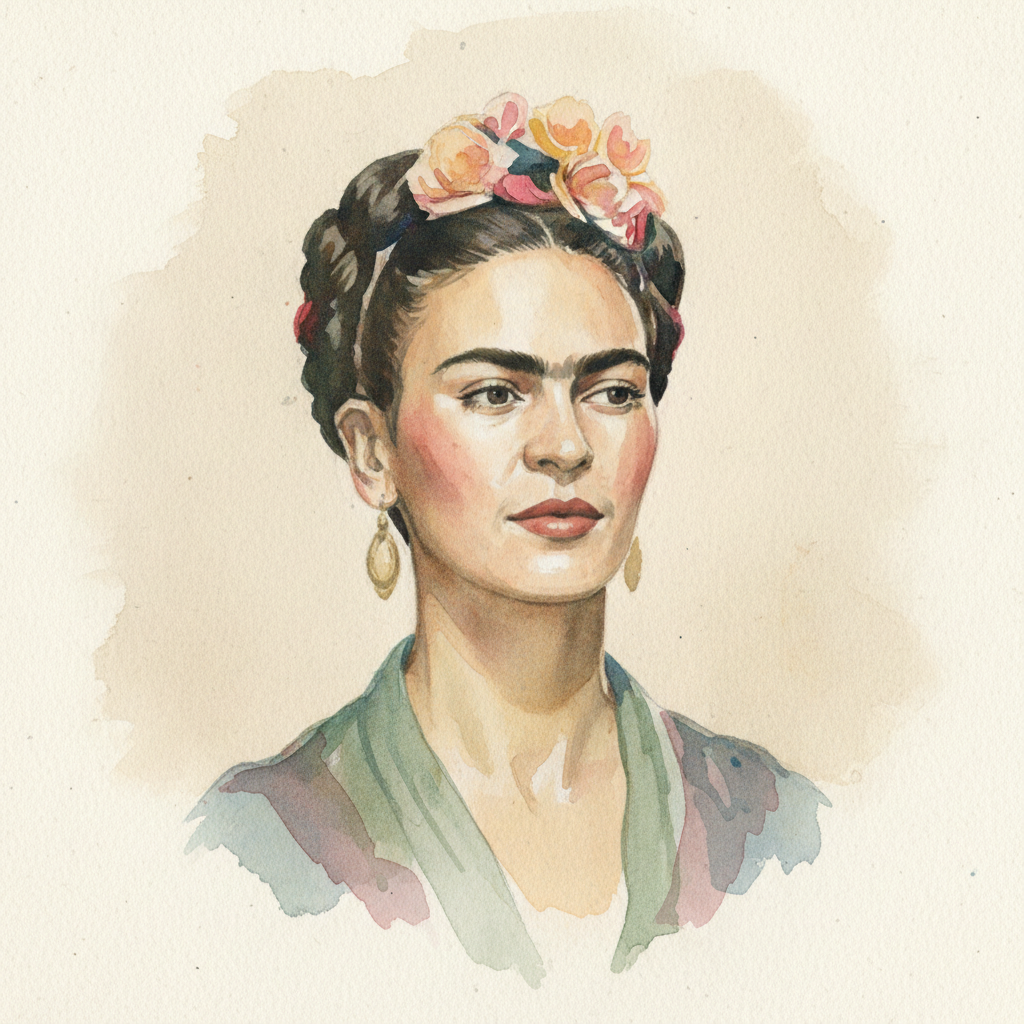
1907–1954 · Artist / Survivor
Frida Kahlo
“I am my own muse. I am the subject I know best. The subject I want to know better.”
Mexican painter. At six she contracted polio, which left her right leg thinner than her left. At eighteen, a Mexico City streetcar collided with the bus she was riding; an iron handrail pierced her pelvis. She spent months in a body cast and was never free of pain again — over thirty surgeries, miscarriages, an amputated leg in her last years. She began to paint in bed, on a canvas her mother rigged above her. She painted herself — at least fifty-five self-portraits — because, she said, she was the subject she knew best, and because she was often alone. She married the muralist Diego Rivera in 1929 — a stormy, unfaithful partnership on both sides; they divorced and remarried. She had affairs of her own, with men and women, including Trotsky. Her work is small in scale, ferocious in nerve. Blood, broken columns, animals, Mexican folk traditions, hospital beds, the doubled self. She refused to flatter her own pain or pretend it away. She was a committed communist, wore traditional Tehuana dress as defiance, and only had one solo show in Mexico in her lifetime — she attended it from a four-poster bed wheeled into the gallery. Core teaching: you do not need to wait until you are healed to make the work. The wound itself can be looked at, painted, named — not to glorify it, but to refuse to lie about it. Key works: *The Two Fridas* (1939), *The Broken Column* (1944), *Henry Ford Hospital* (1932), *Self-Portrait with Thorn Necklace and Hummingbird* (1940), *The Wounded Deer* (1946), her *Diary*.
Known for
- Chronic pain
- Self-portraiture
- Mexican identity
- Truth-telling about the body
- Defiance through beauty
Best for
- Chronic illness
- Body image
- Heartbreak
- Betrayal
- Hard Times
- Identity
Their signature question
“What if you stopped pretending the pain isn't there and painted it instead?”